


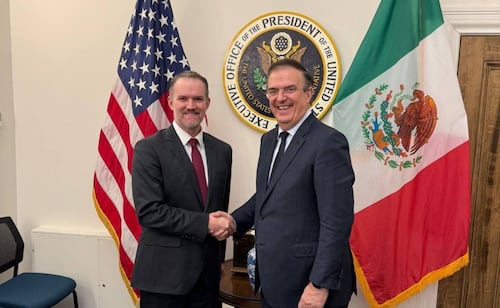
US trade chief meets Mexico's Ebrard to discuss deficit, rules of origin
Translated from Spanish, summarized and contextualized by DistantNews.
At a glance
News
Sources not specified
New plan
- U.S. Trade Representative Jamieson Greer met with Mexico's Economy Secretary Marcelo Ebrard in Washington D.C. to discuss trade.
- Key topics included the U.S. trade deficit with Mexico and strengthening rules of origin under the USMCA.
- The officials also discussed reducing dependence on Asian manufacturing and investigating forced labor practices.
Jamieson Greer, the head of the U.S. Trade Representative's office, met with Mexico's Secretary of Economy, Marcelo Ebrard, in Washington D.C. to address the significant trade deficit the United States holds with Mexico. The discussions also focused on refining the rules of origin within the United States-Mexico-Canada Agreement (USMCA) and curbing reliance on Asian supply chains.
we can find a better balance of trade between the United States and Mexico
Greer emphasized the U.S. government's objective to reduce trade deficits with various economies, including Mexico. He noted that while the USMCA was not expanded, the agreement's continuation until 2036, with annual reviews, presents an opportunity to enhance the bilateral trade relationship.
One of the ways we can achieve this (reducing the trade deficit) is by ensuring that the rules of origin associated with the agreement are stricter, that they promote the inclusion of U.S. content, and that they prevent the inclusion of content from Asia and other places
During a Fox News interview, Greer explained that the meeting with Ebrard involved extensive talks on achieving a more balanced trade flow. He suggested that stricter rules of origin could be implemented, requiring a higher percentage of U.S. content in goods exported to the American market. This would also aim to limit the inclusion of components from Asia and other regions.
We are not looking to give preferential treatment to goods that cross the border between the United States and Mexico if they do not have a lot of U.S. content, or if they mostly contain parts from third countries
Greer further stated that preferential treatment would not be given to goods crossing the U.S.-Mexico border if they lack substantial American content or are primarily composed of parts from third countries. The meeting occurred amidst ongoing investigations into forced labor practices, which could lead to the imposition of 10% tariffs.
We are carrying out investigations under section 302, a power that the United States Trade Representative's office has. Currently, we have investigations into Canada and Mexico in relation to laws on forced labor
DistantNews Editorial
Originally published by El Universal in Spanish. Translated, summarized, and contextualized by our editorial team with added local perspective. Read our editorial standards.
More Stories


From Our Blog

What Press Freedom Means for the News You Read

What Gets Lost (and Found) When News Is Translated

The Critical Role of Diaspora Media in Global News

What Travellers Should Know About Countries with Restricted Press

A Digital Nomad's Guide to Following Local News
