

US travel map flags Russia, North Korea as 'no-go' zones
Translated from Spanish, summarized and contextualized by DistantNews.
At a glance
News
Sources not specified
New plan
- - The U.S.
- State Department issued a travel advisory map classifying countries by security risk levels, ranging from
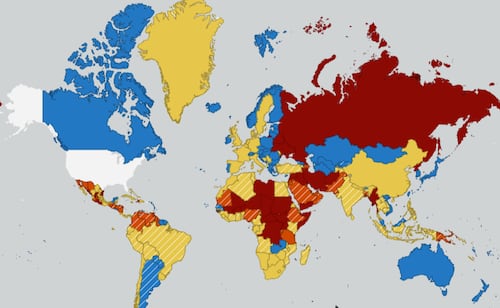
The U.S. State Department has released a "Travel Advisories" map that categorizes countries based on their security risk levels, urging U.S. citizens to exercise caution when traveling abroad. The map uses a color-coded system, with "Blue" (Level 1) indicating normal precautions, "Yellow" (Level 2) suggesting increased caution, "Orange" (Level 3) advising reconsideration of travel, and "Red" (Level 4) warning against travel altogether.
Several countries are listed as safe for travel, including Canada, Paraguay, Argentina, El Salvador, Australia, Japan, South Korea, and Portugal. However, the advisory also highlights countries where travelers should exercise caution, such as Brazil, Peru, Bolivia, Chile, China, India, Spain, France, Italy, Germany, the United Kingdom, and South Africa.
More concerning are the nations flagged with high-risk warnings, including Venezuela, Colombia, Saudi Arabia, Bangladesh, Nigeria, Honduras, Nicaragua, Pakistan, and others. The U.S. government strongly advises against travel to countries like Russia, North Korea, Iran, Iraq, Syria, Haiti, Nigeria, the Republic of Congo, Ukraine, and Somalia, citing risks of terrorism, crime, and kidnapping.
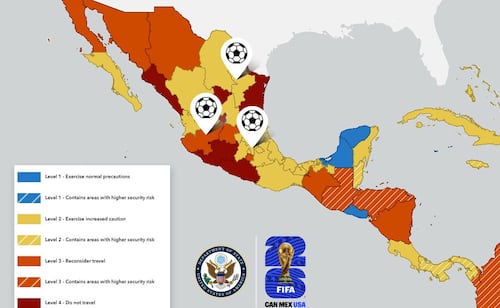
Mexico is uniquely categorized on a state-by-state basis, with some regions falling into the "Do Not Travel" category, a distinction noted as unusual. The advisory specifically mentions risks of terrorism, crime, and kidnapping in these areas. With the 2026 FIFA World Cup approaching, the U.S. Embassy in Mexico is reminding ticket holders to consult the latest travel advisories for their destinations within the country.
DistantNews Editorial
Originally published by El Universal in Spanish. Translated, summarized, and contextualized by our editorial team with added local perspective. Read our editorial standards.
More Stories

From Our Blog

What Press Freedom Means for the News You Read

What Gets Lost (and Found) When News Is Translated

The Critical Role of Diaspora Media in Global News

What Travellers Should Know About Countries with Restricted Press

A Digital Nomad's Guide to Following Local News
