


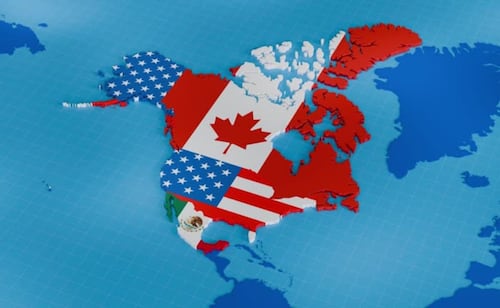
USMCA Not 'Bulletproof,' Mexican Exporters Warn, Urging Stronger Legal Certainty Amid Annual Reviews
Translated from Spanish, summarized and contextualized by DistantNews.
At a glance
News
Named sources
Context piece
- Mexican export business leaders state that the USMCA trade agreement is not "bulletproof" due to annual reviews.
- They urge strengthening legal certainty as the agreement faces yearly scrutiny until its expiration in 2036.
- While the USMCA provides stability, the annual reviews necessitate enhanced compliance, documentation, and transparency in foreign trade operations.
Mexican export business leaders have expressed concern that the United States-Mexico-Canada Agreement (USMCA) is not fully secured, citing the annual review process as a key vulnerability. Eva María Muñoz, president of the Mexican Association of Customs Brokers (Amacarga), stated that while the agreement remains in effect, it has not been "bulletproofed."
The USMCA will conclude in 2036, as the United States opted not to extend it to 2042, leaving a decade of annual reviews. Muñoz emphasized that this period requires "preparation, permanent dialogue, and decisions based on technical evidence."
Muñoz explained that future reviews will demand higher levels of regulatory compliance, document traceability, and transparency in foreign trade operations. This will involve increasingly rigorous validation of information related to the origin of goods and all electronic documentation supporting each shipment. She added that North America's competitiveness will depend on the region's ability to anticipate changes and strengthen logistics as a strategic pillar for economic development.
Despite these challenges, Muñoz noted that the treaty's continuity provides stability for North American trade. However, the annual reviews make it essential to bolster legal certainty, digitalize logistics, and ensure the participation of international customs brokers as strategic players in Mexican foreign trade. Amacarga participated in public consultations, submitting a technical document with recommendations focused on trade facilitation, logistics digitalization, regulatory efficiency, institutional coordination, and recognizing the role of international customs brokers.
DistantNews Editorial
Originally published by El Universal in Spanish. Translated, summarized, and contextualized by our editorial team with added local perspective. Read our editorial standards.
More Stories


From Our Blog

What Press Freedom Means for the News You Read

What Gets Lost (and Found) When News Is Translated

The Critical Role of Diaspora Media in Global News

What Travellers Should Know About Countries with Restricted Press

A Digital Nomad's Guide to Following Local News
