


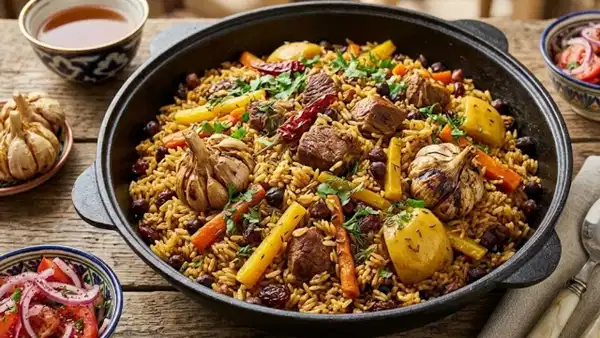
Uzbek pilaf recipe: A feast from the depths of history
Translated from Turkish, summarized and contextualized by DistantNews.
At a glance
News
Sources not specified
Context piece
- Uzbek pilaf, a hearty dish featuring caramelized carrots, tender lamb, and whole garlic, is presented as a substantial main course.
- The recipe details ingredients including rice, lamb or beef, carrots, onions, garlic, oil, cumin, salt, and pepper.
- Step-by-step instructions guide the preparation, emphasizing slow cooking for the meat and a specific method for layering and steaming the rice.
Uzbek pilaf, known locally as 'Plov,' transcends the definition of a simple rice dish, standing as a robust and flavorful main course in its own right. This culinary creation is celebrated for the sweet, caramelized notes of its carrots, the melt-in-your-mouth texture of slow-cooked lamb or beef, and the aromatic infusion from a whole head of garlic cooked at its center.
The recipe calls for specific ingredients to achieve its authentic taste. Key components include 2 cups of baldo or basmati rice, soaked in warm, salted water, and 400 grams of medium-fat lamb or beef, cut into cubes. Three large carrots, julienned into thin strips, and two large onions, sliced for caramelization, form the vegetable base. A whole head of garlic, with outer husks lightly peeled but cloves intact, is essential for aroma. The recipe also specifies half a cup of vegetable oil (traditionally mixed with tail fat), a teaspoon of cumin seeds, and salt and pepper to taste.
Preparation involves a meticulous, slow-cooking process. Meat is browned at high heat in a wide, heavy-bottomed pot until deeply colored. Onions are then added and sautéed until thoroughly caramelized, contributing to the pilaf's signature dark hue. Julienne carrots are added and softened before spices, cumin, salt, and pepper, are incorporated. Hot water is added to cover the meat, and the whole garlic head is placed in the center. This mixture simmers for 30-40 minutes until the meat is tender.
Finally, the prepared rice, rinsed to remove excess starch, is spread evenly over the meat and carrot mixture without stirring. More hot water is added to cover the rice by about one finger's width. The heat is turned up until the water reaches the rice level, then reduced to the lowest setting for 20 minutes of steaming. For serving, the pot is traditionally inverted onto a large platter, ensuring the meat and vegetables are presented on top.
DistantNews Editorial
Originally published by Cumhuriyet in Turkish. Translated, summarized, and contextualized by our editorial team with added local perspective. Read our editorial standards.
More Stories



From Our Blog

What Gets Lost (and Found) When News Is Translated

The Critical Role of Diaspora Media in Global News

What Travellers Should Know About Countries with Restricted Press

A Digital Nomad's Guide to Following Local News

How the Same Story Looks Different in Different Countries
