


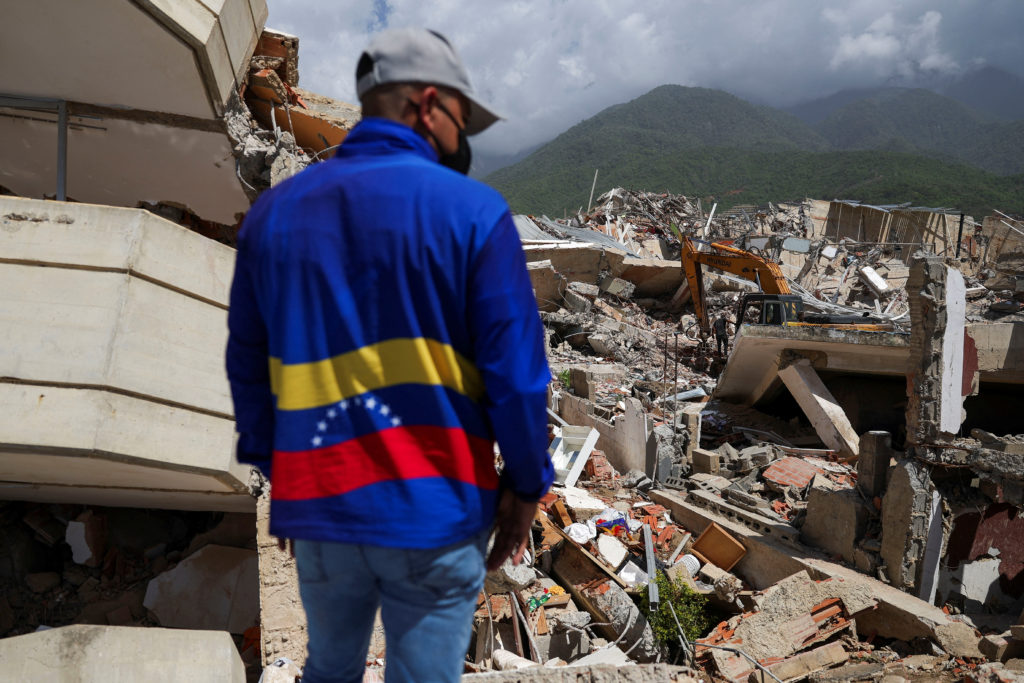
Venezuela's 'ineffective' government worsens earthquake disaster, experts say
Translated from English, summarized and contextualized by DistantNews.
At a glance
News
Sources not specified
Ongoing story
- Venezuela faces a complex humanitarian emergency exacerbated by back-to-back earthquakes, with experts citing government ineffectiveness.
- Pre-existing conditions like lack of medicines, power outages, and widespread displacement have left millions vulnerable.
- The government's official death toll is considered a vast undercount, with international bodies procuring body bags and estimating tens of thousands missing.
Venezuela's already dire humanitarian situation has been severely worsened by recent earthquakes, with experts pointing to a "completely ineffective" government response.
the sustained collapse of a society
Before the twin quakes struck on June 24, the country was grappling with a "sustained collapse of a society," according to Phil Gunson, a senior analyst for International Crisis Group. Decades of democratic backsliding, corruption, and economic hardship had left hospitals without basic medicines and equipment, and daily power outages were common. This pre-existing crisis had already forced nearly 8 million Venezuelans to flee the country in the past decade.
The earthquakes, measuring 7.2 and 7.5 magnitude, have plunged citizens into deeper vulnerability. Civilians have resorted to digging through rubble with their bare hands, desperately seeking assistance. Laura Cristina Dib, director for Venezuela at the Washington Office on Latin America, stated that the government's insufficient and uncoordinated response has left citizens in a state of "deep vulnerability."
left citizens in a situation of deep vulnerability
While the Venezuelan government reported 2,295 deaths and 11,000 injuries, these figures are widely believed to be a significant undercount. The United Nations is procuring 10,000 body bags, and UN emergency relief coordinator Tom Fletcher called an estimate of 50,000 missing people "terrifyingly plausible."
terrifyingly plausible
DistantNews Editorial
Originally published by PBS NewsHour in English. Translated, summarized, and contextualized by our editorial team with added local perspective. Read our editorial standards.
More Stories


From Our Blog

How the Same Story Looks Different in Different Countries

What Gets Lost (and Found) When News Is Translated

The Critical Role of Diaspora Media in Global News

What Travellers Should Know About Countries with Restricted Press

A Digital Nomad's Guide to Following Local News
