


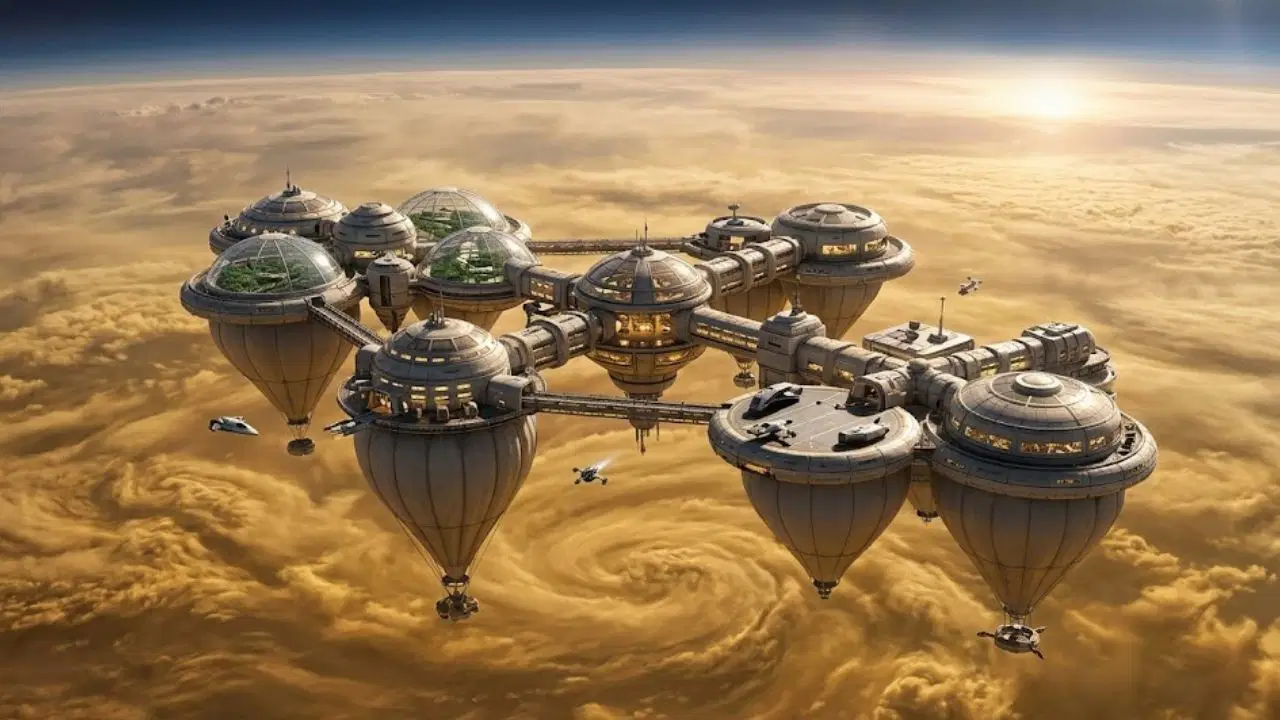
Venus's atmosphere could be humanity's next address, not Mars, scientists propose
Translated from Turkish, summarized and contextualized by DistantNews.
At a glance
News
Sources not specified
Context piece
- Scientists propose Venus as a potential future human habitat, focusing on its atmosphere 55 kilometers above the surface.
- This atmospheric layer offers Earth-like temperatures, pressure, and gravity, making it more accessible than Mars due to shorter travel times and more frequent launch windows.
- Challenges like hurricane-force winds and sulfuric acid rain exist, but researchers believe advanced materials and resilient architecture can overcome them, potentially aiding Earth's climate crisis efforts.
Venus, often perceived as a hellish inferno with surface temperatures capable of melting lead, may harbor a surprising potential for human habitation. Scientists are looking to the planet's atmosphere, approximately 55 kilometers above the surface, as a viable location for future settlements.
This specific atmospheric layer boasts conditions remarkably similar to Earth's, including comparable temperatures, pressure, and gravity. This makes it a more attractive prospect than Mars for several logistical reasons. The distance between Earth and Venus can be as short as 38 million kilometers, compared to Mars' minimum of 56 million kilometers. This proximity significantly reduces travel time for spacecraft, cutting journeys to Venus to around 97 days, while Mars missions typically take at least seven months.
Furthermore, launch windows for Venus are more frequent, occurring every 19 months compared to Mars' 26-month cycle. This ease of access simplifies resupply missions and astronaut returns. The shorter travel duration also minimizes exposure to cosmic radiation, a major hazard for astronauts on deep space voyages.
The concept involves constructing "floating cities" within Venus's atmosphere, which is rich in carbon dioxide and acts as a natural radiation shield. These cities, resembling giant zeppelins, would maintain Earth-normal air pressure internally. This internal pressure, combined with the external carbon dioxide environment, would create buoyancy, allowing the structures to remain suspended. The near-identical gravity to Earth would also prevent the bone and muscle degradation seen in Mars's lower gravity.
However, establishing a presence on Venus is not without its challenges. The atmosphere at this altitude experiences winds reaching up to 370 kilometers per hour, and sulfuric acid clouds pose a significant threat. Scientists are confident that these obstacles can be overcome. They point to the development of advanced polymer materials, similar to Teflon, which demonstrate high resistance to corrosive environments and are already in use on Earth. The development of hurricane-resistant architecture and technologies for producing food in confined spaces for these Venusian colonies could also offer valuable solutions for combating climate change and natural disasters on Earth.
DistantNews Editorial
Originally published by Cumhuriyet in Turkish. Translated, summarized, and contextualized by our editorial team with added local perspective. Read our editorial standards.
More Stories



From Our Blog

What Gets Lost (and Found) When News Is Translated

The Critical Role of Diaspora Media in Global News

What Travellers Should Know About Countries with Restricted Press

A Digital Nomad's Guide to Following Local News

How the Same Story Looks Different in Different Countries
