

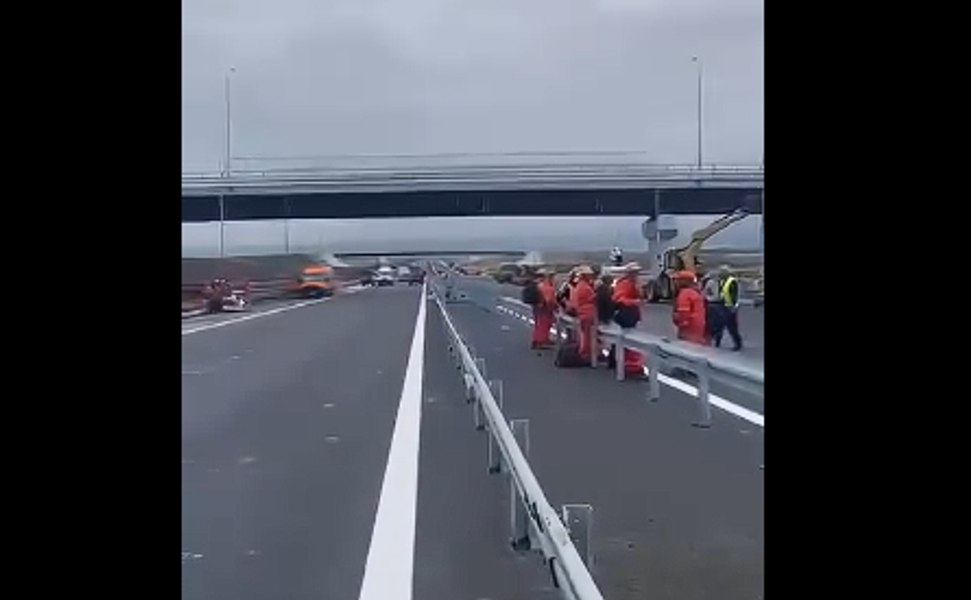

Via Carpatia highway, linking Europe's north and south, takes shape
Translated from Romanian and summarized by DistantNews. Read the original for the full story.
At a glance
News
Sources not specified
Ongoing story
- The Via Carpatia corridor, a major European road infrastructure project, is progressing and aims to connect the port of Klaipėda in Lithuania to Thessaloniki, Greece.
- The approximately 3,000-kilometer route will traverse seven countries: Lithuania, Poland, Slovakia, Hungary, Romania, Bulgaria, and Greece, with potential extensions into Turkey.
- Romania plays a significant role in the corridor's continuity towards Southern Europe, with parts of the route overlapping with existing Pan-European Corridor 4.
The Via Carpatia corridor, one of Europe's most ambitious road infrastructure projects, is steadily taking shape, promising to revolutionize transportation between the continent's north and south. This expansive route is set to connect the port of Klaipėda in Lithuania with the Greek city of Thessaloniki, spanning approximately 3,000 kilometers across seven European nations.
Initially conceived in 2006 by Lithuania, Poland, Slovakia, and Hungary, the project evolved in 2010 with the inclusion of Romania, Bulgaria, and Greece, extending its reach to Thessaloniki. More recently, Turkey has joined the initiative, with plans for a southern branch reaching the Bulgarian-Turkish border and potentially extending to Istanbul.
Construction began in stages between 2010 and 2015, involving the modernization of existing roads into highways and expressways. Optimistic estimates suggest the entire European corridor could be completed by 2030. Via Carpatia is envisioned as a primary transport axis for Eastern Europe, expected to significantly boost regional trade, investment, and connectivity.
Within Romania, the Via Carpatia route will traverse the western and southern parts of the country. Marian Vasile, former vice-president of the Timiș County Council, explained in 2012 that the route would enter Romania near Oradea and exit at Calafat. He noted that parts of the Via Carpatia would overlap with Romania's existing Pan-European Corridor 4, a fortunate situation that could facilitate the project's realization and economic benefits.
"The highway that will connect the North of Europe with the South will mean benefits and development in economic, tourism, cultural exchange, and cross-border cooperation," Vasile stated in 2012. He also mentioned that the route would split in Timiș County, with one branch heading towards the Black Sea via the Pan-European 4 highway and another towards the Romanian-Bulgarian border at Calafat-Vidin.
The highway that will connect the North of Europe with the South will mean benefits and development in economic, tourism, cultural exchange, and cross-border cooperation.
About this summary
Originally published by Adevărul in Romanian. Translated, summarized, and contextualized automatically by DistantNews, with a note on how the source frames the story. Not individually reviewed before publishing. How this works.
More Stories
From Our Blog

What Gets Lost (and Found) When News Is Translated

The Critical Role of Diaspora Media in Global News

What Travellers Should Know About Countries with Restricted Press

A Digital Nomad's Guide to Following Local News

How the Same Story Looks Different in Different Countries
