


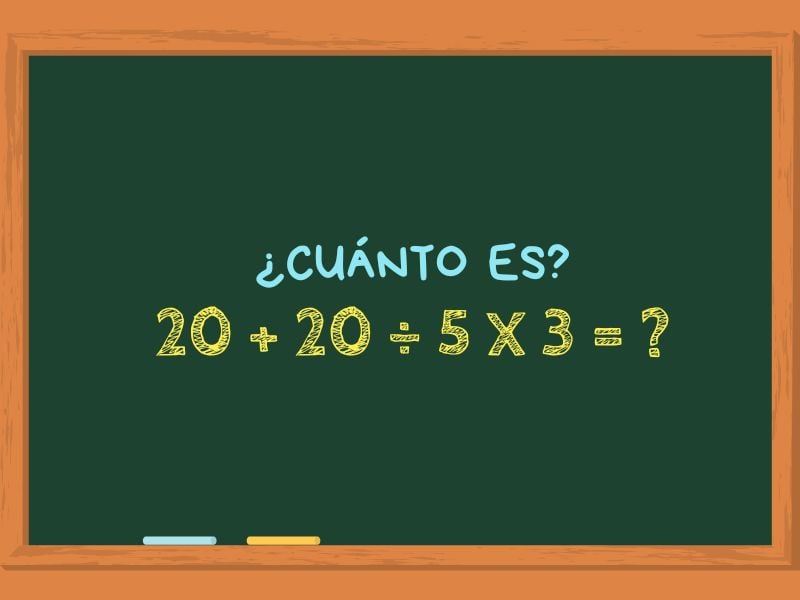
Viral Math Problem Sparks Debate: Can You Solve 20 + 20 ÷ 5 x 3 in Under 40 Seconds?
Translated from Spanish, summarized and contextualized by DistantNews.
At a glance
News
Sources not specified
Context piece
- A viral math problem, "20 + 20 ÷ 5 x 3 = ?", has sparked debate online, with many incorrectly calculating the answer as 10.
- The correct solution, 32, is achieved by following the order of operations (PEMDAS/BODMAS).
- Solving such problems benefits cognitive functions like logic, reasoning, and memory.
A seemingly simple math problem has ignited a fierce online debate, with countless individuals struggling to arrive at the correct answer for "20 + 20 ÷ 5 x 3 = ?". The equation went viral after being shared by a teacher on X, formerly Twitter, prompting widespread confusion and disagreement.
Many participants incorrectly concluded the answer was 10, overlooking a fundamental rule of arithmetic. The key to solving this problem lies in adhering to the established order of operations, often remembered by acronyms like PEMDAS (Parentheses, Exponents, Multiplication and Division from left to right, Addition and Subtraction from left to right) or BODMAS.
Following this hierarchy, the division and multiplication must be performed before the addition. First, 20 ÷ 5 equals 4. Then, 4 x 3 equals 12. Finally, 20 + 12 results in 32. This step-by-step process ensures accuracy and highlights how ignoring the order of operations can lead to incorrect results.
Beyond serving as a mental challenge, engaging with such mathematical exercises offers significant cognitive benefits. Research, including a study from Princeton University published in the Journal of Neuroscience, suggests that practicing calculations strengthens brain areas associated with logic, reasoning, and memory. These exercises can enhance decision-making abilities and improve overall cognitive function.
DistantNews Editorial
Originally published by La Nación in Spanish. Translated, summarized, and contextualized by our editorial team with added local perspective. Read our editorial standards.
More Stories



From Our Blog

What Gets Lost (and Found) When News Is Translated

The Critical Role of Diaspora Media in Global News

What Travellers Should Know About Countries with Restricted Press

A Digital Nomad's Guide to Following Local News

How the Same Story Looks Different in Different Countries
