


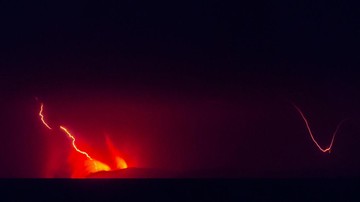

Volcanic ash from Mount Anak Krakatau reaches Jakarta
Translated from Indonesian and summarized by DistantNews. Read the original for the full story.
At a glance
News
Official statement
Ongoing story
- Indonesia's meteorological agency detected two ash-distribution clusters from Mount Anak Krakatau at 4 a.m. local time on Sunday.
- One cluster extended toward Jakarta, Banten and West Java up to 20,000 feet, while another reached areas from Banten toward Lampung at elevations up to 50,000 feet.
- Soekarno-Hatta International Airport was temporarily closed until 9:30 a.m. local time because ash had reached Jakarta and Banten.
Ash from Mount Anak Krakatau reached Jakarta after the volcano began erupting on Friday night, according to Indonesia's Meteorology, Climatology and Geophysical Agency, known as BMKG.
BMKG reported two ash-distribution clusters at 4 a.m. local time on Sunday. The first moved toward Jakarta, Banten and West Java. Ash from the surface to 20,000 feet was observed toward the northeast and south, covering parts of Jakarta, Banten and West Java and nearby waters.
The second cluster extended from the southwest toward the northwest. It covered parts of Banten, Lampung and Bengkulu, the southern Sunda Strait and the Indian Ocean west of Bengkulu, Lampung and Banten. Ash in that area reached from the surface to 50,000 feet.
Because the ash had reached Jakarta and Banten, Soekarno-Hatta International Airport was temporarily closed until 9:30 a.m. local time.
Based on information from PVMBG and VAAC Darwin, as well as analysis of Himawari-9 RGB imagery on Sept. 6, 2026, two clusters of volcanic ash from Mount Anak Krakatau were identified.
About this summary
Originally published by CNN Indonesia in Indonesian. Translated, summarized, and contextualized automatically by DistantNews, with a note on how the source frames the story. Not individually reviewed before publishing. How this works.
More Stories

From Our Blog

News in Translation: What Gets Lost, and How We Keep the Framing

Diaspora Media: How Communities Follow News From Home

Traveling Where the Press Is Not Free: How to Read the News There

The Digital Nomad's Guide to Local News

The Same Story, Different Countries: How Coverage Changes at the Border
