

Washington moves against Cuban doctors' scheme; considers it 'forced labor'
Translated from Spanish, summarized and contextualized by DistantNews.
At a glance
News
Sources not specified
New plan
- The U.S. State Department has imposed sanctions on Cuban medical brigades, calling it a form of "forced labor" and human trafficking.
- These medical missions are a primary source of foreign currency for the Cuban government, generating billions of dollars annually.
- Several countries have ended agreements with Cuba for these medical missions, while Mexico still maintains its program.
The U.S. Department of State announced sanctions against Cuban medical brigades, a major source of foreign currency for the Miguel Díaz-Canel government, and energy sector entities. The department threatened repercussions for those conducting business or maintaining ties with the sanctioned parties. The State Department accused the Cuban regime of maintaining a "policy or practice of forced labor, a form of human trafficking, within the governmental labor export program, including its medical missions abroad."
It alleged that the Cuban government "confiscates between 50% and 95% of the salaries paid by host countries." The statement added that "tens of thousands of medical workers in over 50 countries are subjected to this exploitation, which has historically made medical missions one of Cuba's largest sources of foreign exchange."
The U.S. Department of State accused the Cuban regime of maintaining “a policy or practice of forced labor, a form of human trafficking, within the governmental labor export program, including its medical missions abroad.
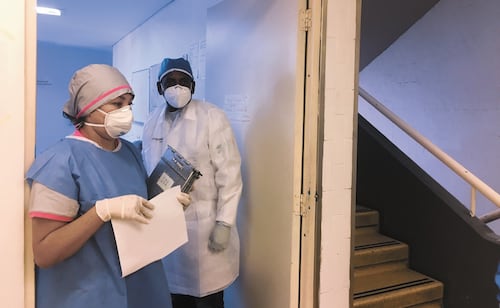
The deployment of medical brigades abroad is the primary source of foreign income for Cuba's communist government, reportedly generating $7 billion in 2025, according to official figures. Last year, approximately 24,000 Cuban doctors and other health professionals worked in 56 countries. However, in recent months, Guatemala, Honduras, Jamaica, and Guyana have terminated these agreements, some of which had been in place for over 25 years. Mexico continues to participate in the program.
The Cuban government “confiscates between 50% and 95% of the salaries paid by host countries.
Washington has now included the Comercializadora de Servicios Médicos Cubanos (CSMC), the Unidad Central de Cooperación Médica (UCCM), its director Gretza Sánchez Padrón, and Health Minister José Ángel Portal Miranda among those sanctioned. Simultaneously, the State Department sanctioned three Cuban energy sector entities and four others associated with the military and business conglomerate Gaesa, which had changed its status or been transferred in an attempt to evade previous sanctions.
The energy sector companies are the Center for Petroleum Research, Empresa de Energía, and Einarbo, described as an importer of "gas, liquefied gas, and lubricants obtained from Mexico and India." Alongside the sanctions, the State Department issued a warning: "Foreign persons who engage in transactions with persons designated under E.O. 14404, or who operate in the energy, defense and related material, metals and mining, financial services, or security sectors of the Cuban economy, risk being subject to sanctions. Non-U.S. persons, including foreign financial institutions, should proceed with caution regarding any transactions with a sanctioned party under this authority."
Foreign persons who engage in transactions with persons designated under E.O. 14404, or who operate in the energy, defense and related material, metals and mining, financial services, or security sectors of the Cuban economy, risk being subject to sanctions. Non-U.S. persons, including foreign financial institutions, should proceed with caution regarding any transactions with a sanctioned party under this authority.
DistantNews Editorial
Originally published by El Universal in Spanish. Translated, summarized, and contextualized by our editorial team with added local perspective. Read our editorial standards.
More Stories

From Our Blog

What Press Freedom Means for the News You Read

What Gets Lost (and Found) When News Is Translated

The Critical Role of Diaspora Media in Global News

What Travellers Should Know About Countries with Restricted Press

A Digital Nomad's Guide to Following Local News
