


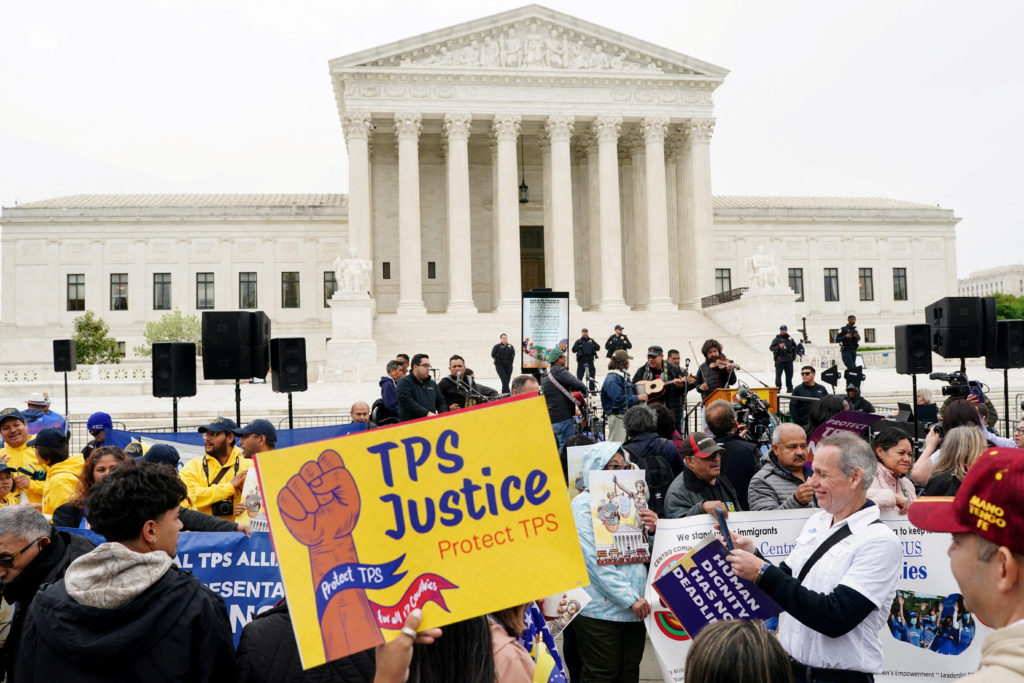
What's next for immigrants with TPS status after Supreme Court ruling?
Summarized and contextualized by DistantNews.
At a glance
News
Named sources
In the courts
- A U.S. Supreme Court ruling has left the legal status of nearly 1.3 million immigrants with Temporary Protected Status (TPS) uncertain.
- The court ruled that judicial review of the Homeland Security secretary's decisions on TPS designations is not permitted.
- This decision places many TPS holders at risk of deportation to dangerous home countries, as courts now defer to the secretary's judgment.
The legal standing of approximately 1.3 million immigrants, who are in the U.S. under Temporary Protected Status (TPS) due to war or environmental disasters in their home countries, is now uncertain following a U.S. Supreme Court decision.
In a 6-3 ruling, the high court determined that the Homeland Security secretary's authority to grant, extend, or terminate a country's TPS designation, which allows individuals from eligible nations to live and work legally in the U.S. for renewable periods of six to 18 months, cannot be subjected to judicial review. The case specifically addressed the former DHS Secretary's decision to end TPS for nearly 350,000 Haitians and over 6,000 Syrians, but legal experts believe the ruling will impact beneficiaries from other TPS-designated countries as well.
Elora Mukherjee, director of the Immigrants' Rights Clinic at Columbia Law School, warned that the ruling places many TPS holders at "almost immediate risk, or immediate risk, depending on the country, of arrest, detention, and deportation." She emphasized that these deportations would not be to safe countries, stating, "Overwhelmingly, individuals with TPS are facing deportation to countries that are too dangerous to return to, as determined by our State Department."
The Court did not rule that ending TPS for Haiti or Syria was sound or that conditions there are safe. It ruled that those judgments belong to the DHS Secretary and are largely insulated from judicial second-guessing.
While the Supreme Court did not rule on the merits of ending TPS for Haiti or Syria or the safety of conditions in those countries, it concluded that such judgments fall under the purview of the DHS Secretary and are largely insulated from judicial scrutiny. Both Haiti and Syria have Level 4 advisories from the U.S. State Department, warning against travel due to risks of crime, terrorism, kidnapping, and unrest.
In the wake of the decision, U.S. Citizenship and Immigration Services has begun setting expiration dates for work permits for most TPS beneficiaries. TPS holders from seven countries, including Haiti and Syria, are slated to lose their legal work authorization on July 10. However, legal experts note this date is a placeholder. The Supreme Court's decision did not immediately terminate TPS but rather remanded the issue to district courts, which are now tasked with issuing an implementation order, leaving TPS holders and their employers in a state of limbo as they await the program's official termination.
And not deportation to a safe country. Overwhelmingly, individuals with TPS are facing deportation to countries that are too dangerous to return to, as determined by our State Department.
DistantNews Editorial
Originally published by PBS NewsHour. Summarized and contextualized by our editorial team with added local perspective. Read our editorial standards.
More Stories


From Our Blog

How the Same Story Looks Different in Different Countries

What Gets Lost (and Found) When News Is Translated

The Critical Role of Diaspora Media in Global News

What Travellers Should Know About Countries with Restricted Press

A Digital Nomad's Guide to Following Local News
