


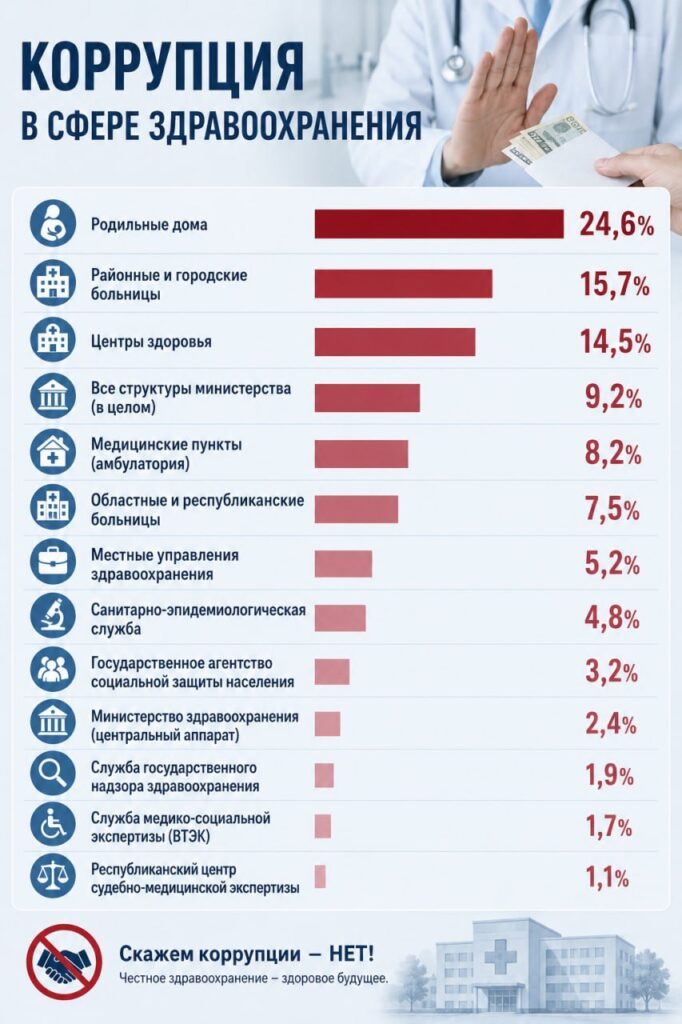
Who Most Frequently Takes Bribes in Tajikistan’s Healthcare Sector?
Summarized and contextualized by DistantNews.
At a glance
News
Named sources
Context piece
- A survey of 10,000 Tajiks found the healthcare sector to be the third most corrupt, with maternity hospitals identified as the most corrupt within the sector.
- The education sector ranked first in overall corruption, followed by the Ministry of Internal Affairs, with the State Automobile Inspectorate being a significant area of bribery.
- Low salaries and difficult living conditions are cited as the main reasons for corruption, yet 86% of those encountering it do not report it, despite over 60% expressing willingness to cooperate in eradicating it.
A recent large-scale survey has shed light on the pervasive issue of corruption within Tajikistan's key sectors, painting a grim picture for citizens seeking essential services. The healthcare sector, in particular, has emerged as a significant site of corrupt practices, with maternity hospitals topping the list of public distrust. This finding is deeply concerning for a nation where access to healthcare is already a challenge for many.
The survey's findings, which place the education sector and the Ministry of Internal Affairs as the most affected by corruption, underscore a systemic problem that requires urgent attention. The fact that the State Automobile Inspectorate is a hotspot for bribery further erodes public confidence in law enforcement and state institutions. It is particularly troubling that a vast majority of citizens who experience corruption choose not to report it, citing reasons such as a lack of awareness of reporting channels, a belief that complaints are futile, or a fundamental distrust in the authorities themselves.
While the survey highlights the deep-seated reasons for corruption, such as low salaries and difficult living conditions, it also offers a glimmer of hope. The willingness of over 60 percent of citizens to cooperate with authorities in eradicating this phenomenon is a powerful testament to the public's desire for change. However, this willingness can only be translated into action if the government demonstrates a genuine commitment to transparency, accountability, and systemic reform. Without such commitment, the cycle of corruption is likely to continue, further burdening the citizens of Tajikistan.
DistantNews Editorial
Originally published by Asia-Plus. Summarized and contextualized by our editorial team with added local perspective. Read our editorial standards.
More Stories


From Our Blog

What Gets Lost (and Found) When News Is Translated

The Critical Role of Diaspora Media in Global News

What Travellers Should Know About Countries with Restricted Press

A Digital Nomad's Guide to Following Local News

How the Same Story Looks Different in Different Countries
