


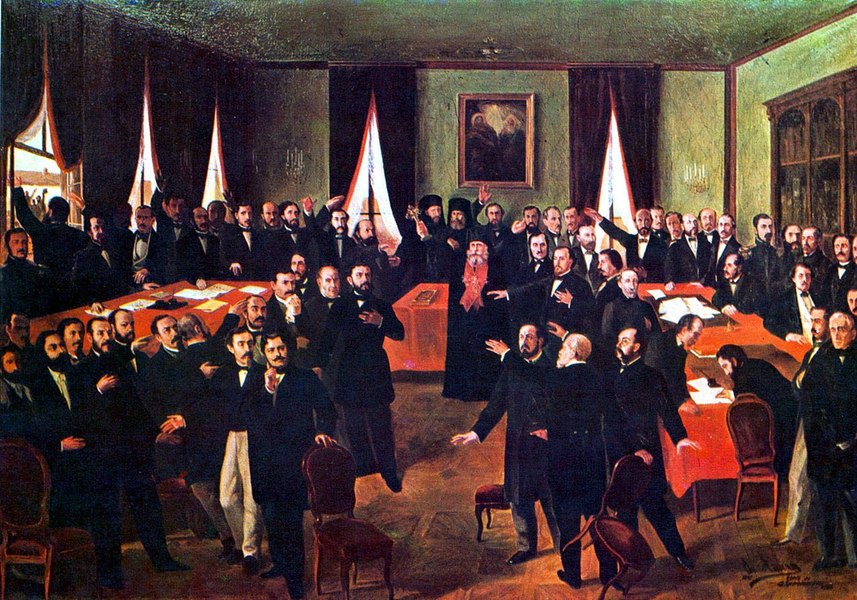
Who Signed the Birth Certificate of the Modern Romanian State? How Western Powers Shaped Our Destiny as a Nation and Their Interests
Translated from Romanian, summarized and contextualized by DistantNews.
At a glance
Analysis
Sources not specified
Context piece
- The modern Romanian state was formed 168 years ago by European Great Powers as a buffer against Russian ambitions.
- The unification of Moldavia and Wallachia in 1859 was driven by political considerations, not solely by Romanian popular will.
- The actual "birth certificate" of the nation was signed in August 1858, when the Great Powers decided to create a buffer state.
The modern Romanian state, formed 168 years ago, owes its existence largely to the strategic decisions of European Great Powers aiming to create a buffer against escalating Russian ambitions. The Principality of United Moldavia and Wallachia, the nucleus of modern Romania, was established primarily for political reasons.
While the communist era often portrayed the state's founding as a result of the Romanian people's exclusive will and mobilizing power, historical context reveals a significant international influence. Like many other nations, Romania's modern formation depended heavily on the international landscape and the dictates of European powers. Romanian diplomatic efforts and patriotic groups played a crucial role in international lobbying, but favorable historical circumstances and geopolitical imperatives were essential for the 1859 union to occur.
The formal act establishing the Romanian nation was not the double election of Alexandru Ioan Cuza in 1859, as commonly believed. Instead, it was the decision made by the Great Powers in August 1858 to constitute a buffer state against Tsarist Russia. This occurred amidst a mid-19th century Europe undergoing profound transformations, marked by the Industrial Revolution, rapid population growth, and significant national and social unrest, including the 1848 revolutions that championed liberalism and nationalism.
At the time, a considerable gap existed between Western Europe and its eastern parts. The Balkans were under Ottoman rule, and the Romanian Principalities faced a dual control: Ottoman suzerainty and Russian protectorate. Romanian patriots had long sought a path to modernity and a strong, civilized state, independent of the Ottoman Empire. Educated in Western Europe, a new Romanian elite emerged, striving for modernization through political, social, and cultural efforts. However, Romania's development remained contingent on international dynamics, as evidenced by the unsuccessful 1848 revolution, where Romanian revolutionaries lacked support and were surrounded by hostile powers like Tsarist Russia, the Habsburg Empire, and the Ottoman Empire.
DistantNews Editorial
Originally published by Adevărul in Romanian. Translated, summarized, and contextualized by our editorial team with added local perspective. Read our editorial standards.
More Stories



From Our Blog

What Gets Lost (and Found) When News Is Translated

The Critical Role of Diaspora Media in Global News

What Travellers Should Know About Countries with Restricted Press

A Digital Nomad's Guide to Following Local News

How the Same Story Looks Different in Different Countries
