


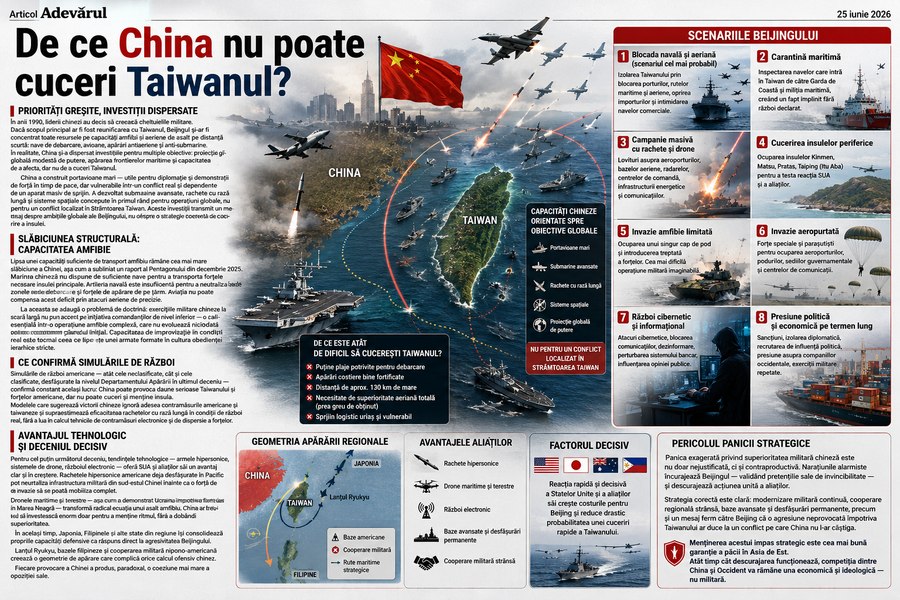
Why China cannot conquer Taiwan?
Translated from Romanian, summarized and contextualized by DistantNews.
At a glance
Analysis
Official statement
Context piece
- China faces strategic limitations that make a forceful conquest of Taiwan improbable, despite its military buildup.
- Key weaknesses include insufficient amphibious assault capabilities and a dispersal of investment across global power projection rather than a focused Taiwan strategy.
- War simulations suggest China can inflict damage but cannot conquer or hold Taiwan, with technological trends favoring the U.S. and its allies for the next decade.
Despite its image as a military superpower, China confronts significant strategic constraints that render a forceful takeover of Taiwan unlikely. While Beijing has increased military spending since the 1990s, its investments have been dispersed across various objectives, including modest global power projection and maritime defense, rather than concentrating solely on the capabilities needed for a Taiwan invasion.
China's development of large aircraft carriers, advanced submarines, long-range missiles, and space systems primarily serves its global ambitions. These assets are more suited for peacetime diplomatic signaling and power demonstrations than for a direct conflict in the Taiwan Strait. A critical vulnerability highlighted by a December 2025 Pentagon report is the lack of sufficient amphibious transport capacity. The Chinese navy lacks the necessary vessels to move the troops required for an island occupation, and its naval artillery is insufficient to neutralize landing zones and coastal defenses. Air power cannot adequately compensate for this deficit.
Furthermore, Chinese military exercises reportedly do not emphasize the initiative of lower-level commanders, a crucial trait for complex amphibious operations that rarely go according to plan. The army's strict hierarchical culture hinders improvisation under real combat conditions. Unclassified and classified U.S. war simulations over the past decade consistently indicate that while China can inflict severe damage on Taiwan and U.S. forces, it cannot successfully conquer and occupy the island. Models suggesting Chinese victories often overlook U.S. and Taiwanese countermeasures and overestimate the effectiveness of long-range missiles in real-world scenarios, failing to account for electronic warfare and force dispersion tactics.
For at least the next decade, technological trends such as hypersonic weapons, drone systems, and electronic warfare are expected to provide a clear and growing advantage to the U.S. and its allies. The U.S. has already deployed hypersonic missiles in the Pacific, further bolstering its strategic position.
DistantNews Editorial
Originally published by Adevărul in Romanian. Translated, summarized, and contextualized by our editorial team with added local perspective. Read our editorial standards.
More Stories
From Our Blog

What Gets Lost (and Found) When News Is Translated

The Critical Role of Diaspora Media in Global News

What Travellers Should Know About Countries with Restricted Press

A Digital Nomad's Guide to Following Local News

How the Same Story Looks Different in Different Countries
