


Why climate change threatens Nepal’s hydropower sector
Translated from English and summarized by DistantNews. Read the original for the full story.
At a glance
Analysis
Documents & data
Ongoing story
- A glacier collapse above Nepal’s Bhotekoshi River buried settlements, destroyed hydropower facilities and killed more than 1,250 people across Nepal and Tibet, according to the article.
- The disaster affected 901.1 megawatts across operational and under-construction projects, while more than 100 workers were initially unaccounted for at Upper Trishuli-1.
- Repeated monsoon losses show that climate-risk assessment must shape hydropower siting, design, construction and operations from the start.
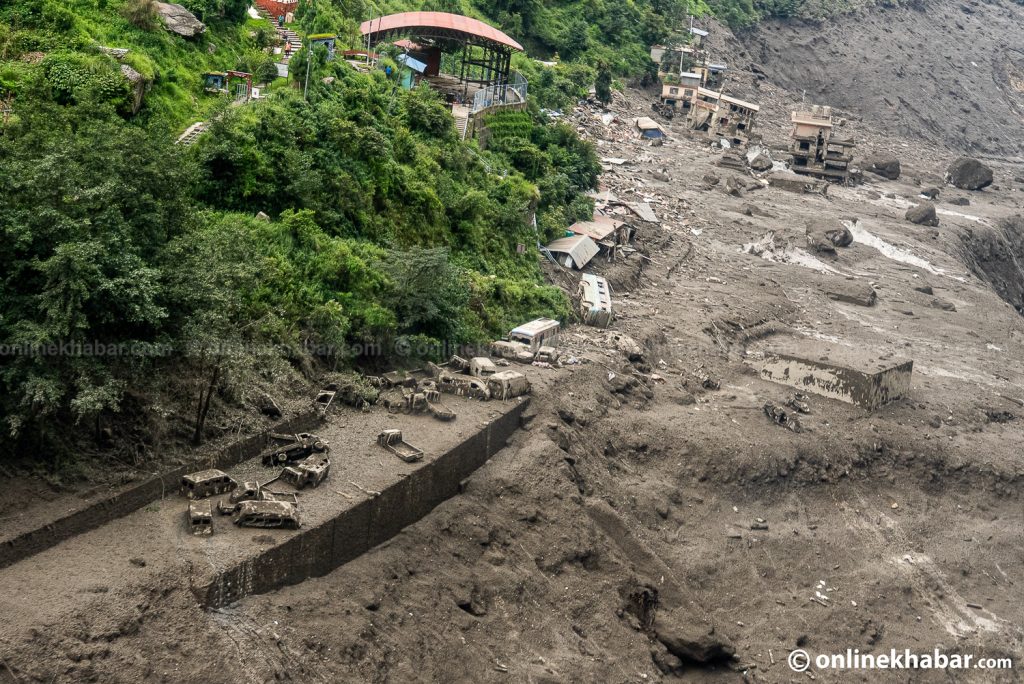
A glacier collapse above Nepal’s Bhotekoshi River buried settlements, swept away hydropower stations and killed more than 1,250 people across Nepal and Tibet. The toll was still rising a week later, and the disaster exposed how unprepared Nepal’s hydropower sector remains for intensifying climate hazards.
The collapse occurred on Aug. 26 above the river in the Lhende catchment on the Nepal-China border. It affected 12 operating projects with 431.1 megawatts of capacity and 15 projects under construction with another 470 megawatts. More than 100 workers were unaccounted for in the first days at the 216-megawatt Upper Trishuli-1 project alone.
The destruction followed a pattern that Nepal’s hydropower industry has faced during every major monsoon since 2021. Floods and landslides affected 26 projects in 2021, causing 5 billion rupees in losses. In 2023, 30 projects representing 463 megawatts were hit, with losses of 8.5 billion rupees. That year, a flash flood at Super Hewakhola in Sankhuwasabha killed 18 workers. Another 26 facilities suffered damage in 2024, generating losses of more than 5 billion rupees. Direct losses across the three monsoons reached 18.5 billion rupees, with private developers bearing the heaviest impact.
The scale of the Bhotekoshi and Trishuli floods is still being calculated, but the article argues that climate change is already a recurring operational threat, not a distant possibility. Nepal has focused on limiting the environmental damage caused by hydropower, including through a hydropower-specific environmental-impact assessment manual. Its implementation remains uneven, while the risks posed by the environment to projects have received less attention.
Climate-risk assessment, the article says, should guide where projects are built, how large they are, their design standards and long-term operations. Assessments need to account for changing river flows, extreme floods, glacial and landslide-dam outburst floods, debris flows, landslides, sedimentation and changing glacial lakes. Structural defenses may help, but the article also calls for catchment-scale nature-based and non-structural measures.
About this summary
Originally published by Kathmandu Post in English. Translated, summarized, and contextualized automatically by DistantNews, with a note on how the source frames the story. Not individually reviewed before publishing. How this works.
More Stories


From Our Blog

News in Translation: What Gets Lost, and How We Keep the Framing

Diaspora Media: How Communities Abroad Follow Home

Traveling Where the Press Is Not Free: How to Read the News There

The Digital Nomad's Guide to Local News

The Same Story, Different Countries: How Coverage Changes at the Border
