


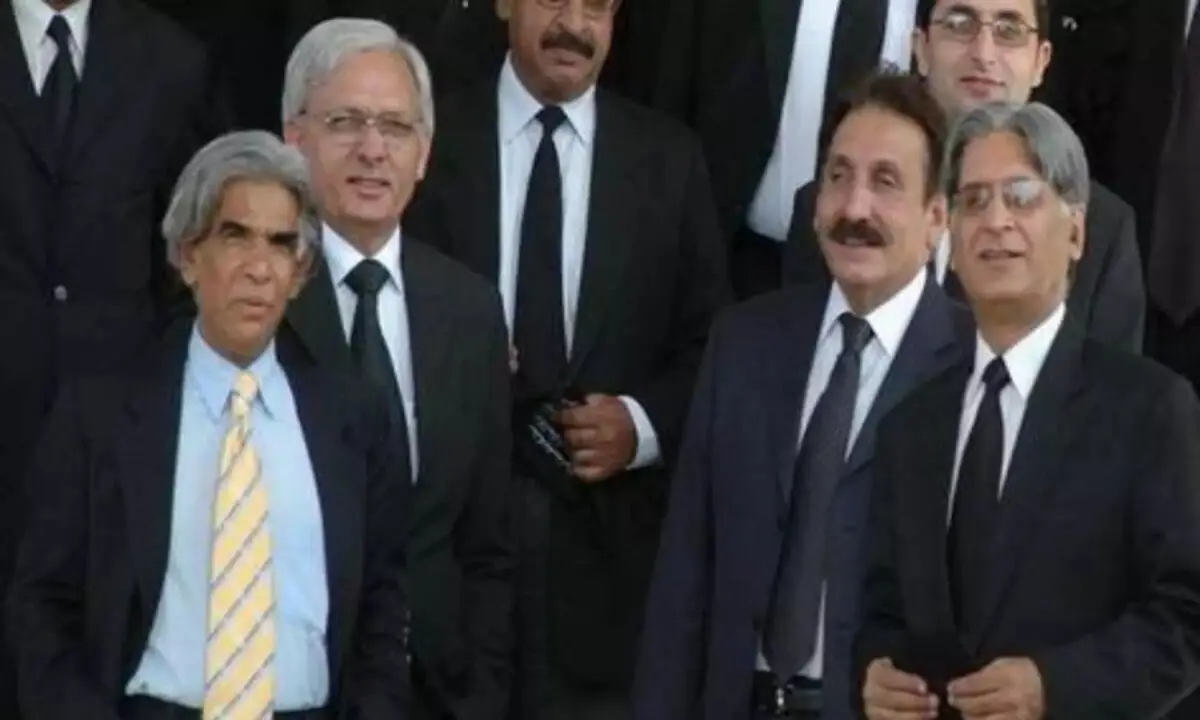
Why Pakistan lacks a lawyers' movement today
Translated from English, summarized and contextualized by DistantNews.
At a glance
Analysis
Sources not specified
Context piece
- The 2007-2009 Lawyers' Movement in Pakistan, a significant civic mobilization, began as a dispute over the chief justice's suspension.
- It evolved into a national campaign challenging Gen. Musharraf's rule, ultimately restoring the Constitution and democratic governance.
- The article explores why a similar movement does not exist today, suggesting the conventional explanation overlooks the movement's success in transforming a constitutional issue into a compelling national narrative.
The Lawyers' Movement of 2007-2009 stands as a pivotal moment of civic action in Pakistan's history. What started as a protest against the suspension of the chief justice of Pakistan rapidly escalated into a nationwide campaign. This movement directly challenged the authoritarian rule of Gen. Pervez Musharraf.
The movement's immediate success was marked by the reinstatement of several deposed judges. However, its deeper significance lay in its role in restoring constitutional order, ending a decade of dictatorial governance, and paving the way for a return to democratic principles. Crucially, it reaffirmed the idea that political authority must stem from the people's will, not from unelected power centers.
While lawyers, judges, and political parties all played roles, the conventional understanding of the movement's success often overlooks a fundamental element. This critical factor was the movement's extraordinary ability to weave a constitutional dispute into a powerful national narrative that resonated across the country.
Understanding how this narrative was constructed is key to explaining the current absence of a comparable lawyers' movement in Pakistan today. The article delves into the factors that enabled this transformation, suggesting that the unique circumstances and the way the movement framed its cause were essential to its impact and its subsequent lack of replication.
DistantNews Editorial
Originally published by Dawn in English. Translated, summarized, and contextualized by our editorial team with added local perspective. Read our editorial standards.
More Stories



From Our Blog

What Gets Lost (and Found) When News Is Translated

The Critical Role of Diaspora Media in Global News

What Travellers Should Know About Countries with Restricted Press

A Digital Nomad's Guide to Following Local News

How the Same Story Looks Different in Different Countries
