


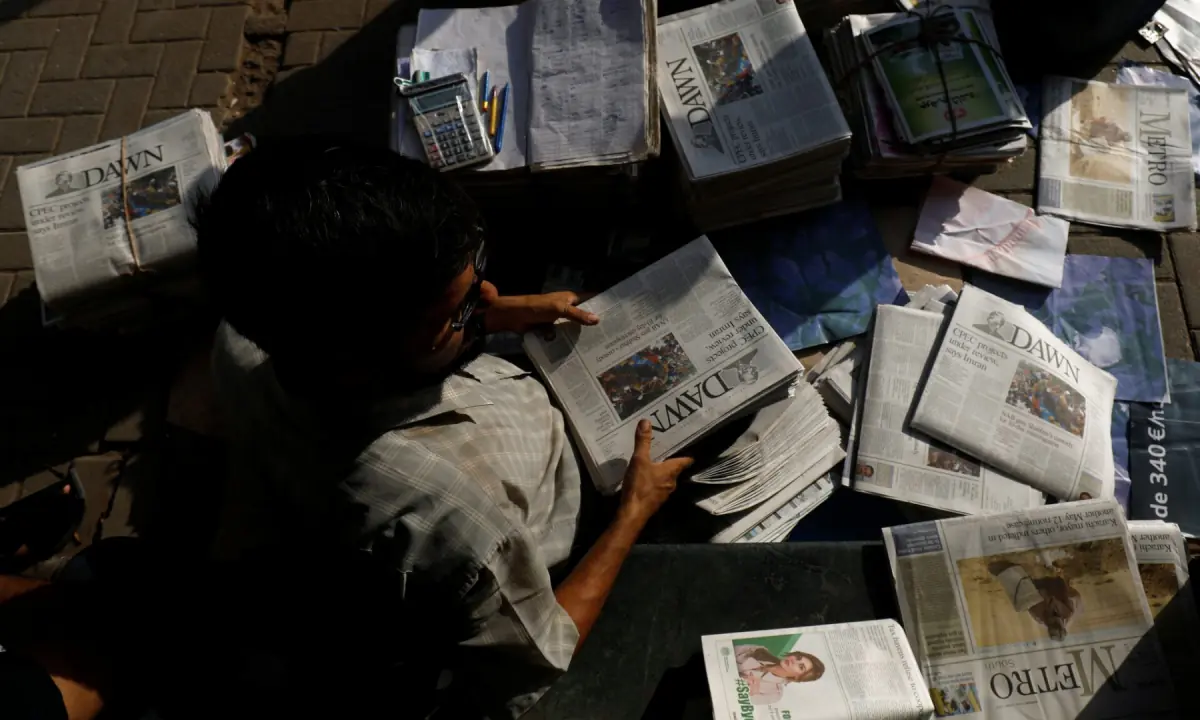
Why regime change won't save free speech in Pakistan
Summarized and contextualized by DistantNews.
At a glance
Analysis
Documents & data
Context piece
- Pakistan's response to mass illegal surveillance in 2024 was a new law, not accountability, according to an EU report.
- The article argues that authoritarianism is systemic in Pakistan, rooted in colonial-era laws, not just the current regime.
- To foster political speech, the system must be dismantled, confronting historical repression and resisting new control mechanisms.
Pakistan's reaction to revelations of mass illegal surveillance in 2024 was not accountability, but rather the enactment of a new law, highlighting a persistent and serious issue with freedom of expression and access to information, as noted in the EU's latest GSP+ assessment.
limitations to the freedom of expression and access to information remain serious and persistent.
A pervasive fear has stifled public discourse in Pakistan, with the state increasingly authoritarian and distrustful of its citizens' voices. Dissent, whether from the public, the press, or online platforms, is met with legal charges and investigations. Silence has become the primary means of ensuring safety from a system intent on suppressing criticism. The EU report underscores that "limitations to the freedom of expression and access to information remain serious and persistent."
Silence has become the only guarantee of safety from the wrath of a system bent on gagging criticism.
While the current coalition government's open disdain for dissent, exemplified by the Law Minister's threats regarding criticism of foreign policy, demands to block YouTube channels, and the National Cyber Crime Investigation Agency's broad powers to label opposition as anti-state, might suggest a regime-specific problem, the article argues that authoritarianism is deeply embedded within Pakistan's legal and systemic framework. This system, established over seventy-eight years, consistently favors autocrats.
It is tempting to label this problem as regime specific. After all, the coalition government demonstrates open contempt for dissent: the Law Minister warns of uttering anything against foreign policy, 27 YouTube channels of journalists are asked to be permanently blocked, and the National Cyber Crime Investigation Agency (NCCIA) is the latest innovation given free rein to label any opposition as anti-state.
The author contends that dismantling this system, rather than merely replacing the current government, is crucial for political speech to flourish. This requires confronting the legacy of colonial repression, particularly laws like Section 124A of the Penal Code (sedition), which was designed to control political dissent and remains on Pakistan's statute books. The article concludes that Pakistan must resist new innovations for state control while addressing the historical foundations of repression.
Constitutional democracy has always struggled to find its place in our history when the system of law we have built over seventy-eight years favours the autocrat. This system, not merely the people currently operating it, needs to be examined, dissected, dismantled.
DistantNews Editorial
Originally published by Dawn. Summarized and contextualized by our editorial team with added local perspective. Read our editorial standards.
More Stories

From Our Blog

What Gets Lost (and Found) When News Is Translated

The Critical Role of Diaspora Media in Global News

What Travellers Should Know About Countries with Restricted Press

A Digital Nomad's Guide to Following Local News

How the Same Story Looks Different in Different Countries
