


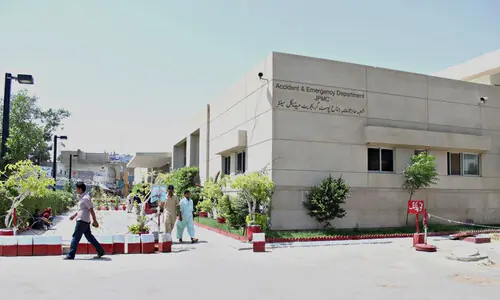
Woman gave birth in Karachi JPMC washroom, inquiry report confirms
Summarized and contextualized by DistantNews.
At a glance
News
Official statement
Outcome reported
- An inquiry committee confirmed that a pregnant woman gave birth in a Jinnah Postgraduate Medical Centre (JPMC) washroom due to negligence by hospital staff.
- The committee found that the woman was denied an ultrasound and advised to walk around despite being in labor, leading to the delivery in the toilet.
- Disciplinary action has been recommended against the resident medical officer (RMO) held responsible, with proposed extensions to the training period for postgraduate doctors on duty.
A pregnant woman delivered her baby in a washroom at Karachi's Jinnah Postgraduate Medical Centre (JPMC), an incident confirmed by an inquiry committee that cited serious lapses in patient care. The committee's report found that the woman, who arrived at the hospital in labor, was not given a timely medical assessment. She was denied an ultrasound examination and was instead advised to walk around.
The failure to properly assess and monitor the patient's condition ultimately resulted in the childbirth occurring in a hospital toilet. The inquiry committee also noted the absence of the consultant and resident medical officer (RMO) from their assigned duties. The report indicates the woman reached the gynaecology ward around 9:30 pm but did not receive the standard evaluation for labor pains.
The incident gained significant public attention after videos of the childbirth in the washroom went viral on social media, sparking criticism of healthcare standards at one of Sindh's largest public hospitals. In response to the public outcry, the Sindh Health Department and JPMC administration formed a three-member committee to investigate the circumstances and identify any negligence. The committee has recommended that the RMO responsible for negligence be referred to the Sindh Health Department for disciplinary proceedings. It also proposed extending the training period of the postgraduate doctors on duty by three months as a disciplinary measure to enhance professional accountability and clinical supervision.
DistantNews Editorial
Originally published by Dawn. Summarized and contextualized by our editorial team with added local perspective. Read our editorial standards.
More Stories



From Our Blog

What Gets Lost (and Found) When News Is Translated

The Critical Role of Diaspora Media in Global News

What Travellers Should Know About Countries with Restricted Press

A Digital Nomad's Guide to Following Local News

How the Same Story Looks Different in Different Countries
