


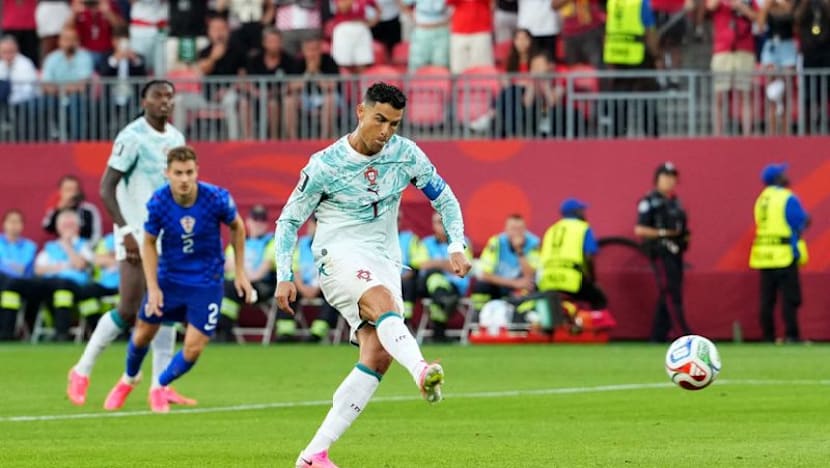
World Cup penalty spot becomes football's newest classroom
Summarized and contextualized by DistantNews.
At a glance
News
From a news agency
Context piece
- Football teams are increasingly treating penalty shootouts as a specialist discipline rather than a lottery, with enhanced preparation.
- Geir Jordet's research shows 53% of players who miss penalties exhibit similar negative post-miss behaviors.
- Nations like England have implemented comprehensive "penalty projects" to improve performance under pressure.
Penalty shootouts, long considered football's "cruellest mind game," are undergoing a transformation, with players, coaches, and goalkeepers increasingly treating them as a specialist discipline requiring rigorous preparation rather than a matter of pure chance.
To not spend time on that is very strange.
Geir Jordet, a professor at the Norwegian School of Sport Sciences and author of "Pressure," argues that the notion of penalties being a lottery should be discarded. He emphasizes that facing a shootout is almost inevitable in successful World Cup campaigns, making dedicated preparation essential. Jordet highlights the significant negative emotional trauma inflicted on players who fail in shootouts, suggesting that neglecting this aspect is "very strange."
Ultimately there will be a young player whose legacy will be defined by the failure in a penalty shootout, which is a massive negative emotional trauma that we're inflicting on this player as a coaching staff, as an FA, and even as a football industry.
Jordet's extensive research, analyzing 718 shots from men's penalty shootouts in major tournaments from 1970 to 2023, revealed that 53 percent of players who miss penalties exhibit similar negative behaviors afterward. These include making themselves appear smaller, falling to the ground, hiding their faces, looking down, or avoiding teammates.
The England story is fascinating. They lost six out of seven penalty shootouts in the '90s and early 2000s. And this was common knowledge in England that we go far in the tournament, we have fantastic talent, and then we lose on penalties. So then they took hold of this and they orchestrated something new. They created these big penalty projects... they're very pioneering and innovative, comprehensive in their approach.
England's experience with penalty shootouts, having lost six out of seven in the '90s and early 2000s, prompted a shift. The country developed "big penalty projects" with a pioneering and comprehensive approach. Spain's coach Luis de la Fuente echoed this sentiment, stating that "kicking a penalty is not something that happens at random." He stressed the need for specialists, similar to free-kick or corner-kick takers, and the importance of focusing on the psychological aspect, acknowledging that it is harder for some players than others.
The FA has a programme in place. We follow this programme in detail, and it's just an important and very specific part of football that comes into play in knockout matches.
DistantNews Editorial
Originally published by CNA. Summarized and contextualized by our editorial team with added local perspective. Read our editorial standards.
More Stories


From Our Blog

What Gets Lost (and Found) When News Is Translated

The Critical Role of Diaspora Media in Global News

What Travellers Should Know About Countries with Restricted Press

A Digital Nomad's Guide to Following Local News

How the Same Story Looks Different in Different Countries
