


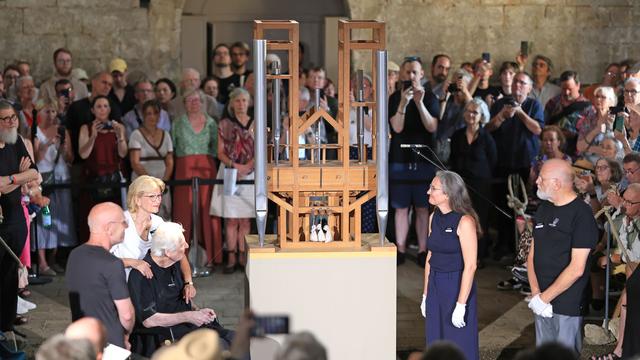
World's slowest concert: John Cage organ piece in Germany marks 17th sound change after 25 years
Translated from German, summarized and contextualized by DistantNews.
At a glance
News
Sources not specified
Ongoing story
- The Burchardi Church in Halberstadt, Germany, is hosting a performance of John Cage's organ piece "ORGAN2/ASLSP" (As Slow As Possible).
- The piece began in 2001 and is scheduled to last 639 years, with sound changes occurring approximately every year.
- The 17th "sound change" recently took place, adding an A' pipe to the organ, as the project continues its centuries-long performance.
In the historic Burchardi Church of Halberstadt, Germany, a unique musical experiment continues to unfold, captivating audiences with its extreme slowness. The church is the venue for John Cage's organ composition "ORGAN2/ASLSP" (As Slow As Possible), a piece that began its performance in 2001 and is meticulously planned to last for 639 years. This duration is a deliberate homage to the completion of the Nicolaus Faber organ in the Halberstadt Cathedral in the year 2000.
Recently, the 17th "sound change" occurred, marking a subtle but significant progression in the performance. This involved adding an A' pipe to the small organ, which now contributes to an eight-tone sound. Anneli Borgmann, who leads the project and chairs the John Cage Organ Foundation Halberstadt, described the evolving sound as creating a "beautiful sound carpet." She noted that the project embodies confidence through its multi-generational continuation, a concept she, as a geoecologist, can appreciate.
It will create a beautiful sound carpet.
The performance is entirely automated, with no organist present. Instead, listeners experience a continuous, soft "wummern" that some compare to a machine room or the port of Hamburg. The pace is so deliberate that nearly 25 years into the performance, only about four percent of the total duration has been realized. Sound changes, or "Klangwechsel," are planned at intervals, with the next scheduled for October 2027 and multiple changes anticipated in 2028 and 2030. This gradual evolution, where 0.2 seconds of the original premiere translate to a month of the current performance, underscores Cage's radical exploration of time and sound.
We are in turbulent times.
DistantNews Editorial
Originally published by Die Zeit in German. Translated, summarized, and contextualized by our editorial team with added local perspective. Read our editorial standards.
More Stories


From Our Blog

What Gets Lost (and Found) When News Is Translated

How the Same Story Looks Different in Different Countries

The Critical Role of Diaspora Media in Global News

What Travellers Should Know About Countries with Restricted Press

A Digital Nomad's Guide to Following Local News
