

World War I Begins and Ends on the Same Date in History: June 28
Translated from Estonian, summarized and contextualized by DistantNews.
At a glance
News
Sources not specified
Context piece
- World War I began with the assassination of Archduke Franz Ferdinand in Sarajevo on June 28, 1914.
- The war formally ended five years later with the Treaty of Versailles, imposing harsh terms on Germany.
- Historians suggest the treaty's conditions contributed to Germany's turn towards Nazism in the 1930s.
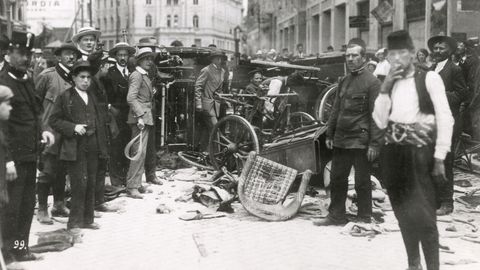
The assassination of Archduke Franz Ferdinand by Gavrilo Princip on June 28, 1914, in Sarajevo, ignited World War I. Princip, a 20-year-old Bosnian Serb and member of the revolutionary movement Mlada Bosna and the secret society Black Hand, was part of a larger conspiracy targeting the Archduke and his entourage.
The ensuing political turmoil rapidly escalated into a continental war, resulting in approximately 10 million deaths. The conflict concluded with the defeat of Germany and its allies, leading to the abdication of Kaiser Wilhelm II and the end of the German Empire. The Austro-Hungarian and Ottoman empires also dissolved in the war's aftermath.
The Treaty of Versailles, signed on June 28, 1919, formalized the war's end. The victorious Allied powers dictated terms to Germany, largely decided in secret negotiations among France, Great Britain, and the United States. Many Germans, including Adolf Hitler, viewed these reparations and restrictions as humiliating. Historians argue that the treaty's terms were a significant factor in Germany's embrace of totalitarian nationalism in the 1930s.
DistantNews Editorial
Originally published by Postimees in Estonian. Translated, summarized, and contextualized by our editorial team with added local perspective. Read our editorial standards.
More Stories
/nginx/o/2026/06/26/17743329t1h09ab.jpg)
/nginx/o/2026/06/25/17742581t1h883b.jpg)
/nginx/o/2026/06/27/17745477t1h2914.jpg)
From Our Blog

What Gets Lost (and Found) When News Is Translated

The Critical Role of Diaspora Media in Global News

What Travellers Should Know About Countries with Restricted Press

A Digital Nomad's Guide to Following Local News

How the Same Story Looks Different in Different Countries
