

/s3/static.nrc.nl/wp-content/uploads/2026/08/26202731/260826BUI_2036203668_sevier.jpg)
/s3/static.nrc.nl/wp-content/uploads/2026/05/18154327/CUL_2033718511_kusama.jpg)
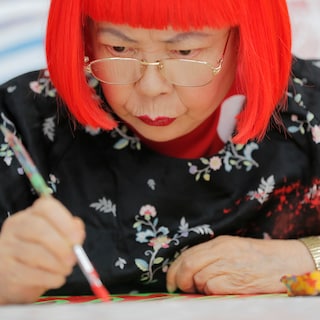
Yayoi Kusama, iconic artist known for polka dots, dies at 97
Translated from Dutch and summarized by DistantNews. Read the original for the full story.
At a glance
News
Sources not specified
Outcome reported
- Japanese artist Yayoi Kusama, famous for her polka dot patterns and infinity mirror rooms, died at age 97.
- Kusama's art was deeply influenced by hallucinations she experienced from a young age, which she translated into her signature dots and immersive installations.
- A major retrospective exhibition of her work is set to open at the Stedelijk Museum in Amsterdam, now serving as a posthumous tribute.
Yayoi Kusama, the influential Japanese artist whose vibrant polka dots and mesmerizing infinity mirror rooms captivated the global art world, has died at the age of 97. Her passing was announced by the Yayoi Kusama Museum and the Yayoi Kusama Foundation. Kusama achieved international fame for her instantly recognizable style, which pushed the boundaries of art through public performances and by transforming art objects into all-encompassing spatial experiences.
There are nights when I cannot sleep, just because my heart overflows with the desire to make art for eternity.
The Stedelijk Museum in Amsterdam is preparing to open a major retrospective of her work on September 11, an exhibition that was developed in collaboration with the Fondation Beyeler in Switzerland and the Museum Ludwig in Germany. The museum described the upcoming exhibition as a "posthumous tribute" to the artist. "The death of Yayoi Kusama is extraordinarily sad news," said museum director Rein Wolfs. "Her art resonates with people worldwide, transcending generations, cultures, and borders. In her work, the distinction between oneself and the surrounding world disappears; you become part of something larger than yourself."
While Kusama's polka dots often evoke a sense of joy and celebration, they originated from a profound and existential place for the artist. Throughout her life, Kusama grappled with hallucinations, visions that instilled both fear and inspiration. The dot pattern, which became her global trademark, first appeared in her childhood drawings, stemming from what she described in her autobiography as "vast fields of dots and flowers." These visions were the catalyst for her becoming an artist, as she wrote, "Painting was a passion born of despair, the only way to survive in this world."
The death of Yayoi Kusama is extraordinarily sad news. Her art resonates with people worldwide, transcending generations, cultures, and borders. In her work, the distinction between oneself and the surrounding world disappears; you become part of something larger than yourself.
Born in Matsumoto, Japan, in 1929, Kusama grew up in her father's seed nursery. Her childhood was marked by difficulty, including a dominant mother who subjected her to emotional abuse and forced her to spy on her adulterous husband. These experiences, which she detailed in her autobiography, contributed to a lifelong complex relationship with sexuality, a theme that frequently appears in her art. Against her parents' wishes, Kusama was determined from a young age to pursue a career in art and escape conservative Japan.
Painting was a passion born of despair, the only way to survive in this world.
About this summary
Originally published by NRC Handelsblad in Dutch. Translated, summarized, and contextualized automatically by DistantNews, with a note on how the source frames the story. Not individually reviewed before publishing. How this works.
More Stories
:format(jpeg):fill(f8f8f8,true)/s3/static.nrc.nl/taxonomy/cc7ceaa-PreciesVier_itemafbeelding.png)
/s3/static.nrc.nl/wp-content/uploads/2026/08/25130948/260826BIN_2035662872_waddenechtpaarDRAGEND.jpg)
From Our Blog

What Gets Lost (and Found) When News Is Translated

The Critical Role of Diaspora Media in Global News

What Travellers Should Know About Countries with Restricted Press

A Digital Nomad's Guide to Following Local News

How the Same Story Looks Different in Different Countries
