


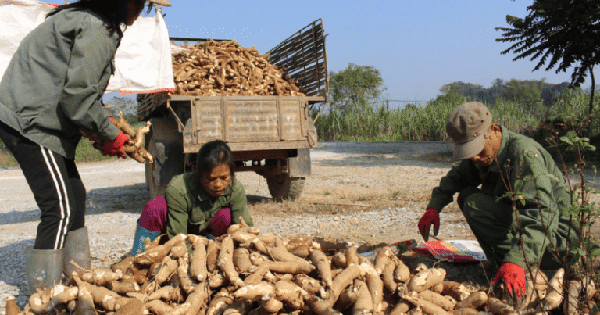
1,001 stories of cassava and ethanol: Countless products from the versatile root
Translated from Vietnamese, summarized and contextualized by DistantNews.
At a glance
In-depth
Named sources
Context piece
- Cassava has become a highly versatile crop due to advancements in processing technology.
- It is used in numerous food products and other bio-industrial applications.
- Traditional methods of processing cassava into flour involved manual grinding and filtering, a labor-intensive process.
Cassava has transformed into a highly adaptable crop, thanks to significant progress in processing technology. Its starch is now a key ingredient in a wide array of food products and plays a role in various other bio-industrial sectors.
Historically, processing cassava roots into flour was a rudimentary and labor-intensive task. In rural areas from the 1980s to the 1990s, the common method involved grinding the fresh roots into a paste. This paste was then filtered to remove coarse materials like the root's fibrous skin and impurities. The heavier starch settled at the bottom of containers, such as tubs or basins, forming a layer that could be collected.
This traditional method was typically a family or small community effort, as machines for finely grinding cassava were not yet widely available. The selection of cassava varieties was also crucial. Sweet cassava, grown in specific soil types like sandy loam, yielded a higher amount of starch. This starch was considered safer, with lower toxicity, compared to later high-yield varieties or even sweet cassava grown in contaminated soil, which could develop a slightly bitter taste when cooked. Scientific literature attributes this bitterness to compounds like hydrocyanic acid (HCN), which can accumulate in the roots depending on the soil and variety.
The manual grinding process for about 50 kilograms of cassava could take two to three hours, depending on the individual's strength. After grinding, the starchy mixture was strained through a fine cloth, like a mosquito net, stretched over a container. Water was added and stirred, allowing the starch to dissolve and pass through, leaving the fibrous residue behind, which was often used as animal feed. After settling overnight, the starch formed a layer at the bottom, and the clear water was decanted, resulting in what is commonly known as 'bot loc' or filtered starch.
By the mid-to-late 1980s, larger, more cumbersome cassava grinding machines, produced by domestic mechanical factories, began to appear. Some cooperatives acquired these machines, or wealthier ones owned a unit. Specialized teams would operate these machines, grinding cassava for cooperative members for a fee. The introduction of these fresh cassava grinding machines significantly eased the burden of manual grinding, a task that was both arduous and sometimes hazardous.
DistantNews Editorial
Originally published by Thanh Niên in Vietnamese. Translated, summarized, and contextualized by our editorial team with added local perspective. Read our editorial standards.
More Stories


From Our Blog

What Gets Lost (and Found) When News Is Translated

The Critical Role of Diaspora Media in Global News

What Travellers Should Know About Countries with Restricted Press

A Digital Nomad's Guide to Following Local News

How the Same Story Looks Different in Different Countries
