


1,400-Year-Old Remains Found at Peruvian Excavation Site
Translated from German, summarized and contextualized by DistantNews.
At a glance
News
Official statement
Outcome reported
- Archaeologists in Lima, Peru, discovered around 1,400-year-old remains believed to be a human sacrifice.
- The remains were found near a ceremonial well and water channel from the Lima culture (450-650 AD).
- The discovery offers new insights into the ritual practices of the Huaca Pucllana site.
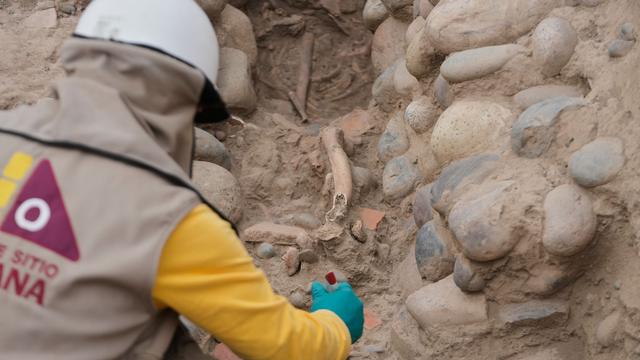
Archaeologists excavating in Peru's capital, Lima, have unearthed the remains of a man believed to be around 1,400 years old, potentially a human sacrifice. The discovery was made at the Huaca Pucllana ruins, a site belonging to the Lima culture, which flourished between 450 and 650 AD.
The archaeological team found the skeletal remains of what is presumed to be an adult male. These remains were reportedly deposited as an offering during the ritual closure of an underground water channel connected to a ceremonial well. Alongside the skeleton, a ceramic snake head was also discovered.
According to the Ministry of Culture, the skeleton was found lying along the channel, oriented north-south, and positioned on its left side. The skull faced west, looking towards the pyramid and the sea. This specific arrangement is interpreted as an intentional placement related to the ritual inauguration of the structure.
Authorities state that this finding provides new understanding of the ritualistic practices at Huaca Pucllana. The site, located in the Miraflores district, is renowned for its stepped pyramid constructed from millions of handmade adobe bricks.
DistantNews Editorial
Originally published by Die Zeit in German. Translated, summarized, and contextualized by our editorial team with added local perspective. Read our editorial standards.
More Stories


From Our Blog

What Gets Lost (and Found) When News Is Translated

How the Same Story Looks Different in Different Countries

The Critical Role of Diaspora Media in Global News

What Travellers Should Know About Countries with Restricted Press

A Digital Nomad's Guide to Following Local News
