


179 Pre-Hispanic Artifacts Found in Chiapas Cave, Mexico
Translated from Spanish, summarized and contextualized by DistantNews.
At a glance
News
Sources not specified
Context piece
- Archaeologists discovered 179 pre-Hispanic artifacts in the Mundo Zoque cave in Chiapas, Mexico.
- The artifacts, including ceramic pieces, were found in 13 ritual deposits.
- The cave's difficult access helped preserve the site, which was likely used for rain and agricultural fertility rituals.
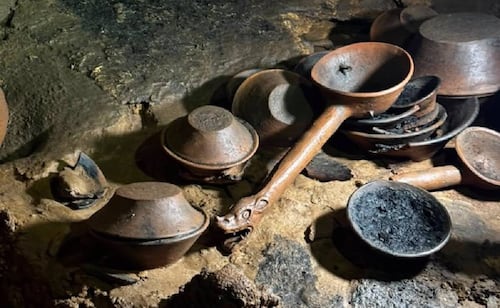
An extraordinary cache of 179 pre-Hispanic archaeological pieces has been unearthed within the Mundo Zoque cave in Cintalapa, Chiapas, Mexico. Specialists from Mexico's National Institute of Anthropology and History (INAH) announced the discovery, made within 13 ritual deposits deep inside the cave system.
The finding, considered one of the most significant in the region in recent decades, was initially reported by a local guide. INAH experts conducted investigations between February and June in the vicinity of the La Venta River canyon. The cave itself, stretching 100 meters long, presents a formidable challenge with an access point requiring a rappel descent of over 10 meters. This difficult entry is credited with keeping the site remarkably intact and free from looting for centuries.
Inside the cave, archaeologists identified numerous ceramic objects, including incense burners, bowls, and effigy urns. Preliminary dating places these artifacts in the Late Classic regional period (600–900 AD). Many of these pieces feature depictions of jaguars, owls, and serpents. Researcher Josuhé Lozada Toledo explained that in Zoque cosmology, these animals are linked to the nocturnal world, with the jaguar guarding the underworld, the owl symbolizing wisdom, and the serpent representing the cycle of life and death.
The cave's interior features narrow passages and a siphon that is only passable during the dry season, leading to ceremonial chambers adorned with stalagmites modified into anthropomorphic forms. In the main chamber, a unique incense burner was discovered. This artifact, measuring 32 centimeters, is decorated with a cross symbolizing the quincunx, or the universe's cardinal directions, and features a handle topped with the open jaws of a serpent.
INAH data suggests the cave was exclusively used for rituals aimed at invoking rain and ensuring agricultural fertility, ruling out its use as a dwelling. Claudia Curiel de Icaza, Secretary of Culture for the Mexican Government, emphasized the importance of collaboration between communities and institutions in preserving exceptional archaeological contexts and expanding knowledge of the country's cultures. Further analysis, including 3D photogrammetry and chemical studies, will be conducted to detect potential residues within the artifacts.
DistantNews Editorial
Originally published by El Universal in Spanish. Translated, summarized, and contextualized by our editorial team with added local perspective. Read our editorial standards.
More Stories



From Our Blog

What Press Freedom Means for the News You Read

What Gets Lost (and Found) When News Is Translated

The Critical Role of Diaspora Media in Global News

What Travellers Should Know About Countries with Restricted Press

A Digital Nomad's Guide to Following Local News
