


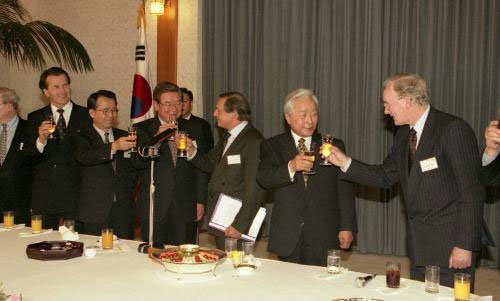
30 Years in OECD: South Korea Still Stuck Below $40,000 Per Capita GDP
Translated from Korean, summarized and contextualized by DistantNews.
TLDR
- South Korea joined the OECD 30 years ago, transforming from a recipient of aid to a major economy, but faces challenges like high elderly poverty and low life satisfaction.
- Despite joining the "developed nations club," the country has been stuck at a per capita GDP of $30,000 for 12 years, unlike other OECD nations that reached $40,000 in 5-6 years.
- The article calls for structural reforms in key areas like regulation, finance, and labor to overcome low growth potential and foster new industries beyond reliance on semiconductors.
As Dong-A Ilbo reflects on South Korea's 30th anniversary of joining the OECD, we must confront a stark reality: our nation, once lauded as a 'superstar' for overcoming the middle-income trap, now finds itself stagnating. While we celebrate the remarkable transformation from aid recipient to a top-tier economy, the persistent issues of high elderly poverty, low life satisfaction, and a widening wealth gap cast a long shadow over these achievements. The dream of a brighter future dims for our youth as the engines of our 'compressed growth' sputter, leaving us stranded at the $30,000 GDP per capita mark for over a decade.
This stagnation is not merely an economic statistic; it's a crisis of national vitality. The potential growth rate has plummeted, and our reliance on the semiconductor industry for exports and stock market performance is a precarious tightrope walk. Unlike the dynamic progress seen in other OECD nations, South Korea's rigid labor market and excessive regulations stifle productivity and innovation. The 'miracle on the Han River' seems to have lost its momentum, and the specter of falling back into the 'middle-income trap' looms larger than ever.
Dong-A Ilbo has long advocated for bold structural reforms, and the current juncture demands decisive action. The government's commitment to reform six key sectors—regulation, finance, public services, pensions, education, and labor—must translate into tangible progress. We cannot afford to be a 'developed nation' in name only. The path forward requires shedding outdated economic models and embracing new technologies and industries with the same vigor that propelled our initial ascent. This is our turning point to ensure a truly advanced future for South Korea.
DistantNews Editorial
Originally published by Dong-A Ilbo in Korean. Translated, summarized, and contextualized by our editorial team with added local perspective. Read our editorial standards.
More Stories


From Our Blog

What Gets Lost (and Found) When News Is Translated

The Critical Role of Diaspora Media in Global News

What Travellers Should Know About Countries with Restricted Press

A Digital Nomad's Guide to Following Local News

How the Same Story Looks Different in Different Countries
