


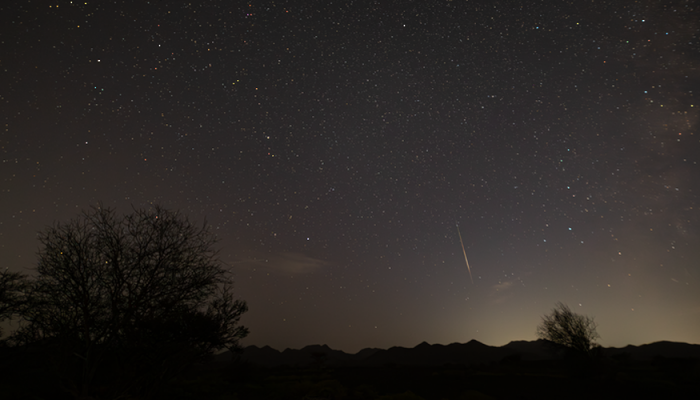
332 Perseid meteors documented in single night in Oman's sky
Summarized and contextualized by DistantNews.
At a glance
News
Sources not specified
Context piece
- Oman's sky recorded 332 meteors from the Perseid meteor shower during its peak night under ideal conditions.
- The observation occurred during a new moon phase, providing a dark sky free from light pollution.
- Data collected helps study meteor shower activity, dust distribution from Comet Swift-Tuttle, and predict future meteor events.
The Sultanate of Oman's night sky was a canvas for celestial activity, with observers documenting 332 meteors from the annual Perseid shower during its peak. Ideal astronomical conditions, including a new moon phase, provided a dark, clear sky, significantly enhancing the visibility of the meteors.
The goal of the documentation process lies in studying the Zenithal Hourly Rate (ZHR), which serves as an important indicator in studying meteor shower activity.
The observation, conducted by seven individuals at a location shielded from light pollution, began before the official documentation period. Initial observations recorded over 35 meteors. Systematic documentation ran from midnight to 4 AM, capturing 297 meteors. The data revealed a pattern of increasing activity throughout the night, peaking between 3 AM and 4 AM with 108 meteors recorded, aligning with the radiant point's higher position in the sky after midnight.
Ibrahim Mohammed Al Mahrouqi, Vice Chairman of the Oman Astronomical Society, explained that the documentation aims to study the Zenithal Hourly Rate (ZHR), a key indicator of meteor shower intensity. Consistent data collection over years allows scientists to understand the distribution of dust and debris left by Comet Swift-Tuttle and to identify periods when Earth passes through denser debris fields. This information aids in developing predictive models for future meteor activity.
Collecting data regularly over years provides information regarding the nature and distribution of dust and debris left behind by the comet "Swift–Tuttle" in its orbit around the Sun.
Furthermore, analyzing the size and distribution of these particles offers insights into the disintegration and evolution of the comet's nucleus over time. This research holds practical significance for understanding space debris and its potential impact on satellites. Al Mahrouqi noted that factors like the radiant point's elevation and Earth's direction of travel influence meteor counts, making the pre-dawn hours optimal for observation. The high number of meteors recorded in the final hour underscores the excellent viewing conditions and the shower's strength during its peak.
Recording more than 100 meteors during the final hour of documentation reflects the quality of observation conditions and relative sky darkness, providing an indicator of the strength of the shower's activity during the peak night.
DistantNews Editorial
Originally published by Times of Oman. Summarized and contextualized by our editorial team with added local perspective. Read our editorial standards.
More Stories



From Our Blog

What Gets Lost (and Found) When News Is Translated

The Critical Role of Diaspora Media in Global News

What Travellers Should Know About Countries with Restricted Press

A Digital Nomad's Guide to Following Local News

How the Same Story Looks Different in Different Countries
