


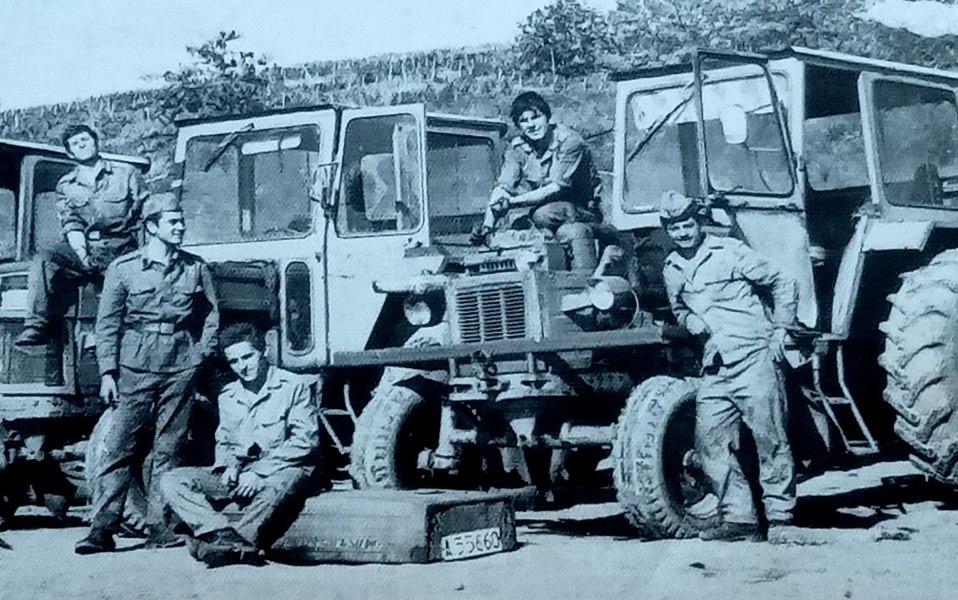
“A slave’s wage on the one-party estate”: Romanians recall patriotic labor during military service
Translated from Romanian and summarized by DistantNews. Read the original for the full story.
At a glance
In-depth
Documents & data
Context piece
- Thousands of conscripts in communist Romania were sent to construction sites, mines, factories and farms during their military service.
- Soldiers worked on major projects including the Transfăgărășan Highway, the Danube-Black Sea Canal and the Palace of Parliament.
- Historical records cited in the article list 5,085 military personnel on the canal project in 1979, while about 12,000 soldiers worked on the Palace of Parliament between 1984 and 1990.
For thousands of young men in communist Romania, military service meant months of labor on the regime's biggest construction sites rather than time inside military units.
For the year 1979, 5,085 military personnel were assigned, including 235 officers, 86 warrant officers, 197 noncommissioned officers and 4,506 conscripts.
Conscripts were sent to farms, factories, mines and industrial projects because the state viewed them as a large, disciplined and easily mobilized workforce. Their labor helped build or develop some of Romania's most prominent infrastructure, including the Transfăgărășan Highway, the Danube-Black Sea Canal and the Palace of Parliament.
A study by historian Adrian Ilie, based on documents from the Constanța National Archives, recorded 5,085 military personnel assigned to the canal project in 1979. The figure included 235 officers, 86 warrant officers, 197 noncommissioned officers and 4,506 conscripts. Soldiers were deployed in large numbers to difficult excavation work, and their presence increased in subsequent years.
They worked in winter, too. They wanted to. Although nowhere in the world do people work on tunnels at such an altitude in winter.
The army also supplied a substantial share of the labor force for the Palace of Parliament, now the seat of Romania's parliament. The building's official website says about 12,000 soldiers took part between 1984 and 1990, during a project that employed nearly 20,000 workers in three shifts at its peak.
The wind blew at 120 kilometers per hour, and the blizzard was so strong that we covered the few dozen meters from the tunnel to the cabin in an hour and a half.
Thousands of soldiers were also mobilized for the Iron Gates I hydroelectric project and for the Transfăgărășan route. The section between Vidraru Dam and Cârțișoara was built from 1970 to 1974, largely by the Romanian Army. Engineer Ioan Gogu recalled workers laboring through winter conditions, with winds reaching 120 kilometers per hour and avalanches carrying away a compressor station twice. The memories remain tied to former military bases, many of which were later abandoned, fell into disrepair and now prompt both nostalgia and bitterness.
Twice, avalanches simply swept away our compressor station.
About this summary
Originally published by Adevărul in Romanian. Translated, summarized, and contextualized automatically by DistantNews, with a note on how the source frames the story. Not individually reviewed before publishing. How this works.
More Stories


From Our Blog

What Gets Lost (and Found) When News Is Translated

The Critical Role of Diaspora Media in Global News

What Travellers Should Know About Countries with Restricted Press

A Digital Nomad's Guide to Following Local News

How the Same Story Looks Different in Different Countries
