

Aachen's Carolingian Throne: Mysteries of a Medieval Seat of Power
Translated from German, summarized and contextualized by DistantNews.
At a glance
News
Named sources
Context piece
- The Aachen Cathedral's Carolingian Throne is a major attraction for its archaic appearance.
- While associated with Charlemagne, its exact historical use by him is debated by experts.
- The throne is a focal point for historical and symbolic interpretations, drawing 1.3 million visitors annually.
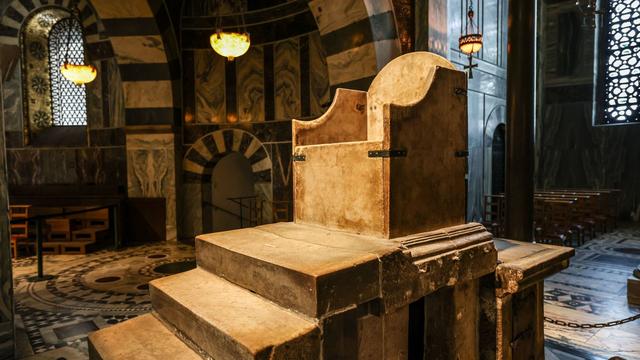
The Carolingian Throne in Aachen Cathedral, Germany, captivates visitors with its seemingly authentic, archaic stone structure, evoking images of the early Middle Ages or even fantasy settings like 'The Lord of the Rings.' Despite its powerful visual presence, the throne's direct connection to Charlemagne, the legendary ruler it's named after, remains a subject of historical debate.
No, I don't think so. The throne was probably placed in this position later. But it cannot be ruled out - the scientist likes to stick to probabilities.
Located on a raised platform within the cathedral's arcades, accessed by a spiral staircase, the throne is a significant draw for the 1.3 million tourists who visit annually. Its simple, unadorned design, in contrast to more ornate royal seats, contributes to its perceived authenticity. The cathedral itself, a UNESCO World Heritage site, served as the coronation site for over 30 German kings in the Middle Ages, adding to the historical weight of the location.
Dombaumeister (Cathedral Master Builder) Jan Richarz expressed skepticism about Charlemagne actually sitting on the throne, suggesting it was likely placed in its current position later. "We cannot genetically examine whether Charlemagne sat on it, so it will be difficult to answer the question definitively," he noted, highlighting the challenges of historical certainty.
Our problem is that so many later historical-symbolic meanings are piled on top of each other on this throne.
Professor Harald Müller from RWTH Aachen University echoed this sentiment, explaining that the throne has accumulated numerous later historical and symbolic meanings. The earliest written mention of the throne as Charlemagne's dates to the mid-11th century, long after his death, referring to it as the "Imperial Throne of the Realm." This layering of historical interpretations makes it difficult to separate fact from legend regarding its original use.
But since we cannot genetically examine whether Charlemagne sat on it, it will be difficult to answer the question definitively.
DistantNews Editorial
Originally published by Die Zeit in German. Translated, summarized, and contextualized by our editorial team with added local perspective. Read our editorial standards.
More Stories



From Our Blog

What Gets Lost (and Found) When News Is Translated

How the Same Story Looks Different in Different Countries

The Critical Role of Diaspora Media in Global News

What Travellers Should Know About Countries with Restricted Press

A Digital Nomad's Guide to Following Local News
