


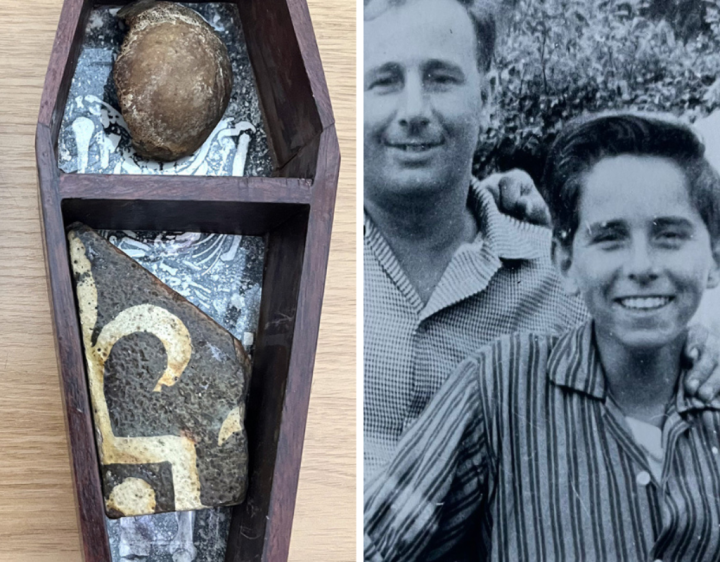
Abbot’s kneecap returned 70 years after it was taken from 13th century grave
Summarized and contextualized by DistantNews.
At a glance
News
Named sources
Outcome reported
- A man's kneecap, stolen from a 13th-century grave at Glastonbury Abbey in 1956, has been returned 70 years later.
- The bone was taken by George Box, then 11, during a school trip and kept in Australia.
- His widow returned the artifact after his death, fulfilling his wish.
A kneecap belonging to an Abbot from the medieval Glastonbury Abbey has been returned to its resting place 70 years after it was stolen by a young boy.
While visiting the abbey, George had noticed a large archaeological excavation taking place. As no one was around, he managed to pick up a piece of medieval floor tile and a piece of bone (a kneecap, in fact) from an opened tomb.
George Box, who passed away last year, was just 11 years old when he took the bone, along with a piece of medieval floor tile, from an open tomb during a school trip in the summer of 1956. He never revealed his actions, even after moving to Australia in the 1970s, where he displayed the items in a glass cabinet.
Following Box's death, his widow discovered the artifacts among his belongings. Remembering his childhood escapade, she decided to fulfill his wish to return the items to the abbey. The abbey's museum department has now received the kneecap and the tile, which are available for public viewing.
The abbey is very grateful for their return, and to have learnt their fascinating story.
Records indicate that the bone likely belonged to one of three abbots buried in the north transept of the Abbey Church during the 13th century. Staff at the abbey noted the unusual journey of the artifact, with one employee humorously suggesting that if they were to excavate the burial sites, one of the abbots might be surprised to find himself with an extra kneecap after its trip to Australia and back.
How surprised would they be to know that one of their kneecaps had travelled to Australia and back.
DistantNews Editorial
Originally published by Global News. Summarized and contextualized by our editorial team with added local perspective. Read our editorial standards.
More Stories


From Our Blog

What Gets Lost (and Found) When News Is Translated

The Critical Role of Diaspora Media in Global News

What Travellers Should Know About Countries with Restricted Press

A Digital Nomad's Guide to Following Local News

How the Same Story Looks Different in Different Countries
