


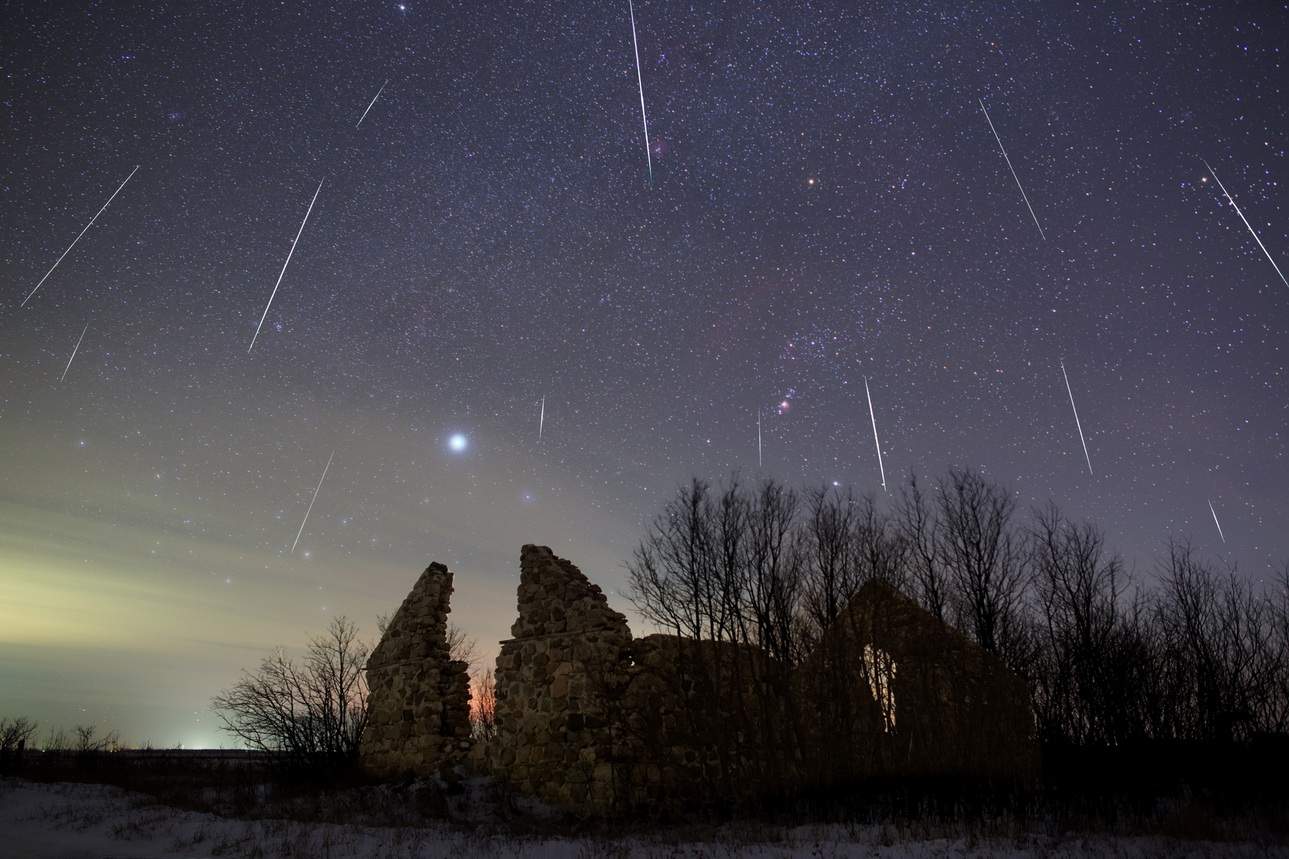
Perseid meteor shower and partial solar eclipse to light up Canadian skies next week
Translated from English, summarized and contextualized by DistantNews.
At a glance
News
Sources not specified
Context piece
- Canadians can witness the peak of the Perseid meteor shower and a partial solar eclipse between August 12-13.
- The Perseid meteor shower occurs annually as Earth passes through debris from Comet Swift-Tuttle, creating streaks of light.
- Optimal viewing for the meteor shower is in darker areas away from cities, while Newfoundland and Labrador is expected to have the best view of the partial solar eclipse.
Canadians are set to experience a spectacular celestial show next week with the peak of the Perseid meteor shower and a partial solar eclipse.
You have to be patient, but it’s a great spectacle if you’re lucky to be in a region where you can see it.
The Canadian Space Agency (CSA) calls the Perseids "the best meteor shower of the year," with peak viewing expected from August 12 to 13. This annual event happens as Earth travels through the debris trail left by Comet Swift-Tuttle. These small particles, upon entering Earth's atmosphere at high speed, vaporize and create the streaks of light we see as meteors.
Pierre Langlois, manager for space astronomy and planetary science missions at the CSA, described the experience as requiring patience but offering a "great spectacle." He likened the event to seeing snowflakes approach a car while driving. The Perseids are generally easier to predict, offering visible shooting stars each year from late July to mid-August.
these bits of debris enter Earth’s atmosphere at a very fast 59 kilometers per second, vaporizing about 80 to 90 kilometers altitude and leaving behind streaks of light we call meteors or shooting stars.
Adding to the astronomical excitement, a partial solar eclipse will occur concurrently. This phenomenon happens when the Moon passes between the Sun and Earth, but they are not perfectly aligned, causing only a portion of the Sun to appear covered. NASA advises using solar eclipse glasses to protect eyes during this event.
It’s a bit like when we’re driving into snow, we see snowflakes coming towards us. That’s exactly what’s happening with these meteor showers.
For the best viewing experience, Langlois recommends getting away from large cities for the meteor shower. Newfoundland and Labrador is anticipated to offer the clearest view of the partial solar eclipse, though not the full event. Globally, Spain and Iceland are expected to have the most prominent views of the solar eclipse. For the meteor shower, later in the night, after the sky is fully dark, is considered the ideal time to watch.
the further you are from big cities, the best chance you have.
DistantNews Editorial
Originally published by Global News in English. Translated, summarized, and contextualized by our editorial team with added local perspective. Read our editorial standards.
More Stories



From Our Blog

What Gets Lost (and Found) When News Is Translated

The Critical Role of Diaspora Media in Global News

What Travellers Should Know About Countries with Restricted Press

A Digital Nomad's Guide to Following Local News

How the Same Story Looks Different in Different Countries
