


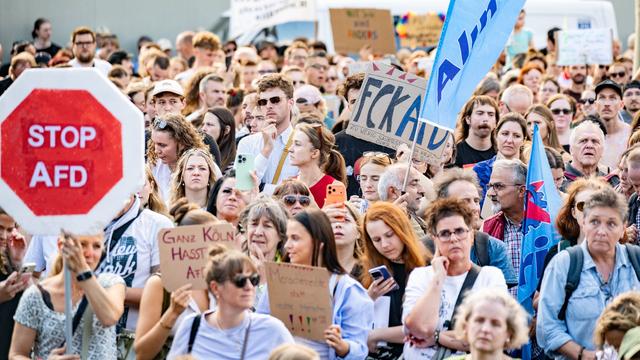

After Saxony-Anhalt election, Greens leader open to nonpartisan candidate
Translated from German and summarized by DistantNews. Read the original for the full story.
At a glance
Newswire
Named sources
Ongoing story
- Green Party leader Felix Banaszak said the party would not block the BSW proposal for a nonpartisan minister president in Saxony-Anhalt.
- The proposal calls for governing through shifting majorities, including the AfD, but AfD leader Tino Chrupalla has rejected the model.
- Banaszak said the Greens remain committed to preventing AfD participation in government and could seek an agreement with other parties on a candidate.
Germany’s Greens are leaving the door open to an unusual proposal for Saxony-Anhalt: a nonpartisan minister president who would govern with changing majorities.
We as the Greens are not closing ourselves off to the idea of a nonpartisan candidate for the office of minister president.
“We as the Greens are not closing ourselves off to the idea of a nonpartisan candidate for the office of minister president,” Green Party leader Felix Banaszak told the news portal t-online. He said the unprecedented situation required “flexibility and creativity.”
The BSW had put forward the idea after the election. Under its proposal, the minister president would govern with shifting majorities, including the AfD. The identity of a possible candidate remains unclear. The SPD had already indicated that it was open to the proposal.
This unprecedented situation requires flexibility and creativity.
AfD leader Tino Chrupalla has rejected the model. For the AfD, he said, “there can only be one minister president, Ulrich Siegmund.” Banaszak stressed that the Greens still wanted to prevent the AfD from taking part in government. If the Greens and other parties could agree on a candidate, he said, his party would be prepared to consider that option.
There can only be one minister president, Ulrich Siegmund.
About this summary
Originally published by Die Zeit in German. Translated, summarized, and contextualized automatically by DistantNews, with a note on how the source frames the story. Not individually reviewed before publishing. How this works.
More Stories
From Our Blog

News in Translation: What Gets Lost, and How We Keep the Framing

The Same Story, Different Countries: How Coverage Changes at the Border

Diaspora Media: How Communities Follow News From Home

Traveling Where the Press Is Not Free: How to Read the News There

The Digital Nomad's Guide to Local News
