


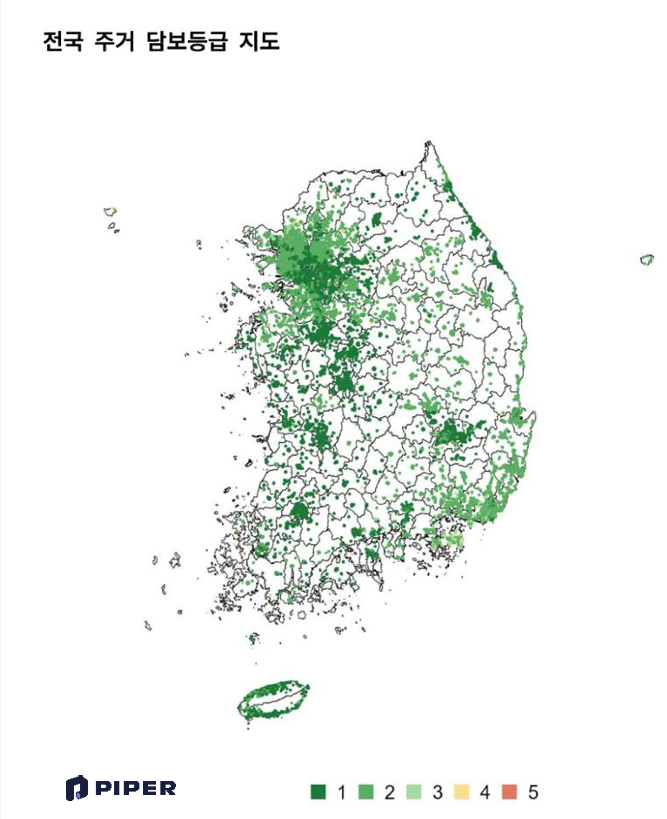
AI assigns 'collateral grades' to 350,000 buildings in South Korea for loan assessments
Translated from Korean, summarized and contextualized by DistantNews.
At a glance
News
Named sources
New plan
- A new AI-driven system assigns 'collateral grades' to over 350,000 multi-unit buildings nationwide in South Korea.
- The system, developed by Spacewalk Value and Prime Appraisal Corp., uses machine learning on data since 2006.
- These grades will be used by financial institutions to assess loan risks for real estate collateral.
South Korea has launched an AI-powered system that assigns 'collateral grades' to over 350,000 multi-unit buildings across the country. Developed by Spacewalk Value, which operates the AI real estate financial service PIPER, in collaboration with Prime Appraisal Corp., the 'Republic of Korea Collateral Loan Grade Map (2026 1H)' classifies the recoverability of collateral loans into five stages.
The system utilizes a machine learning model trained on transaction and auction data since 2006. It analyzes individual unit locations, usage, area, floor, structure, and scale, alongside market transaction and auction trends. This analysis estimates expected auction success rates and sale periods, which are then aggregated at the building level to determine the collateral grade.
The scope includes 300,382 residential multi-unit buildings and 50,020 non-residential ones as of late March. This encompasses apartments, townhouses, and multi-family homes, as well as officetels, commercial properties, lodging facilities, shopping centers, and knowledge industry centers.
Collateral grades range from Grade 1 ('Excellent') to Grade 5 ('Caution'). The system estimates the recoverability of collateral loans even for properties not currently under auction, predicting potential sale prices and timelines should an auction be initiated.
For residential buildings, Grade 2 was the most common, with 171,813 units (57.2%), followed by Grade 1 with 116,427 units (38.76%). Non-residential buildings also saw Grade 2 as the most frequent (58.03% with 29,026 units), but Grade 1 had a lower proportion at 14.34% compared to residential properties.
The average estimated auction success rate was 76.1% for residential and 65.6% for non-residential buildings, with average estimated sale periods of 10.6 and 11.6 months, respectively. Grade 5 properties had estimated auction success rates of 36.6% for residential and 35.5% for non-residential.
Non-residential multi-unit buildings, such as shopping malls, knowledge industry centers, and hotels, often have fewer transaction examples and limited public price information compared to apartments. This new collateral grade system provides a consistent metric for comparing their estimated auction success rates and recovery periods.
Analysis revealed that some open-concept retail spaces, defined only by floor markings without walls, had estimated auction success rates as low as 20-30%. Certain non-residential facilities in large housing development areas or older, small mixed-use buildings also showed rates between 30-40%.
Spacewalk Value is providing these collateral grades to major financial institutions, where they will serve as reference material for loan assessments. The company offers data via API to financial institutions and provides building-specific and unit-specific collateral grade inquiries through 'PIPER Pro' for real estate professionals and individuals.
Park Sung-sik, CEO of Spacewalk Value, explained, "What financial institutions value most in collateral loans is how much and how quickly they can recover funds if a default occurs." He added, "This system allows for the consistent assessment of the collateral value of multi-unit buildings, including commercial properties, knowledge industry centers, and lodging facilities."
What financial institutions value most in collateral loans is how much and how quickly they can recover funds if a default occurs. This system allows for the consistent assessment of the collateral value of multi-unit buildings, including commercial properties, knowledge industry centers, and lodging facilities.
DistantNews Editorial
Originally published by Dong-A Ilbo in Korean. Translated, summarized, and contextualized by our editorial team with added local perspective. Read our editorial standards.
More Stories

From Our Blog

What Gets Lost (and Found) When News Is Translated

The Critical Role of Diaspora Media in Global News

What Travellers Should Know About Countries with Restricted Press

A Digital Nomad's Guide to Following Local News

How the Same Story Looks Different in Different Countries
