

AI Helps Scientists Fully Read Ancient Herculaneum Scroll for First Time
Translated from Polish and summarized by DistantNews. Read the original for the full story.
At a glance
News
Named sources
Outcome reported
- For the first time, scientists have fully read an intact scroll from Herculaneum, carbonized by the Vesuvius eruption in 79 AD, using AI and advanced imaging.
- The Vesuvius Challenge initiative is making all data, code, and digital models of the scrolls publicly available to accelerate research and has offered a $1 million prize for fully reading another scroll.
- The newly read scroll contains 70 columns of text from a work attributed to the philosopher Philodemus, with another papyrus yielding 20 columns from a text dated between 200-300 BCE, making it the oldest virtually unrolled scroll from Herculaneum.
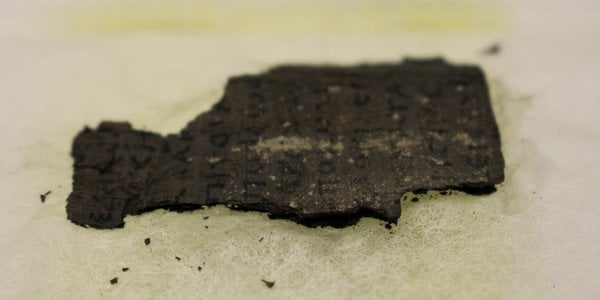
A groundbreaking achievement marks a significant step toward deciphering hundreds of ancient manuscripts discovered in Herculaneum, a Roman city destroyed along with Pompeii during the catastrophic eruption of Mount Vesuvius in 79 AD. The Vesuvius Challenge initiative, which promotes the use of modern technologies to read charred papyri, has announced it will release all data, code, and digital models of the scrolls online to speed up research.
Organizers also announced a $1 million prize for the first person or team to fully read another scroll. "Just a year ago, it would have been madness to think that an entire scroll could be read completely non-invasively, with hundreds of columns of text," said Brent Seales, a computer science professor at the University of Kentucky and a project co-founder, during a conference broadcast from Naples. "Today, we have shown that it is possible. I believe we will read every scroll in this collection."
Scientists used high-resolution scans and computational methods to "virtually unroll" the brittle, carbonized scrolls, which cannot be physically opened without risking destruction. These techniques detect traces of ink on the papyrus layers. To date, about 45 scrolls and fragments have been scanned, with over 600 unopened manuscripts remaining. A significant portion of the villa where they were discovered has yet to be explored, increasing the likelihood of finding more papyri.
Just a year ago, it would have been madness to think that an entire scroll could be read completely non-invasively, with hundreds of columns of text. Today, we have shown that it is possible. I believe we will read every scroll in this collection.
The project has already awarded $1.8 million in prizes for progress in deciphering texts from Herculaneum. Tech entrepreneur and project co-founder Nat Friedman believes the latest advancements pave the way for much faster progress. "We believe our algorithms can still be significantly improved. We also think that the current ink-detection methods have enormous development potential," he said, encouraging more computer scientists to join the project.
Among the materials presented was 70 columns of text from "On Vices, Book I," attributed to the Epicurean philosopher Philodemus. Researchers also deciphered approximately 1.5 meters of text, comprising 20 columns, from another papyrus dated between 200-300 BCE. This represents the oldest virtually unrolled Herculaneum scroll discovered so far, addressing topics of ethics, art, and human behavior. Federica Nicolardi, the lead papyrologist for the Vesuvius Challenge, emphasized the revolutionary nature of these new research methods, noting that previous physical unrolling techniques inevitably damaged the artifacts.
We believe our algorithms can still be significantly improved. We also think that the current ink-detection methods have enormous development potential.
About this summary
Originally published by Rzeczpospolita in Polish. Translated, summarized, and contextualized automatically by DistantNews, with a note on how the source frames the story. Not individually reviewed before publishing. How this works.
More Stories



From Our Blog

What Gets Lost (and Found) When News Is Translated

The Critical Role of Diaspora Media in Global News

What Travellers Should Know About Countries with Restricted Press

A Digital Nomad's Guide to Following Local News

How the Same Story Looks Different in Different Countries
