


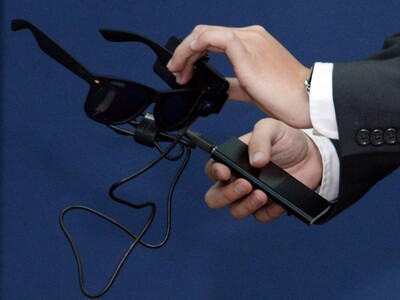
AI-powered smart glasses offer new independence for visually impaired
Translated from Spanish, summarized and contextualized by DistantNews.
At a glance
News
Sources not specified
Context piece
- AI-powered smart glasses are becoming more accessible and offer significant assistance to visually impaired individuals.
- Features include voice commands, object recognition, photo/video capture, translation, and integrated audio.
- Sales of smart glasses are growing rapidly, with Meta holding a dominant market share, though competition is increasing, particularly from China.
Smart glasses are increasingly democratizing technology, with artificial intelligence enhancing their capabilities and making them a valuable aid for people with visual impairments. These high-tech accessories can now respond to voice commands, identify objects the user is looking at, take photos, record videos, receive calls, translate languages, and play music through integrated headphones.
Colette Dentelle, an 83-year-old visually impaired woman, described how her Ray-Ban Meta glasses have transformed her life. "They constantly change my life!" she exclaimed, using them to navigate to the bus stop. "They allow me to get around, to go shopping, telling me what is written on the cans and the price" on labels. She also uses them to find lost keys, stating, "This allows me to remain autonomous."
Market research firm Omdia reports that 8.7 million AI-enabled smart glasses were sold globally in 2025. Data from Counterpoint indicates that shipments of connected glasses (without a visual display) worldwide more than tripled (+210%) in the first quarter of 2026. Meta, in partnership with EssilorLuxottica, maintains a dominant position with its Ray-Ban Meta and Oakley Meta models, capturing approximately 84% of the market share in the first quarter.
While the United States remains the largest market for smart glasses, competition is intensifying in China, with manufacturers like Xiaomi, Huawei, and Rokid emerging, alongside a rapidly expanding market in India. Prices are reportedly falling sharply in these regions. An optician in Paris noted the rapid evolution of the technology, comparing it to the smartphone market, and prefers to stock Meta glasses on demand rather than building inventory.
Recent customers have included a rodeo enthusiast filming her rides and a film producer. The Parisian optician sold half of his stock of 10 pairs in six weeks, noting that sales are neutral for his business unless prescription lenses are also sold, as he must match the manufacturer's online prices. One customer, Ayoub Benheddi, a 24-year-old engineer, had his glasses, including solar corrective lenses, fully covered by his health insurance, costing around 500 euros.
DistantNews Editorial
Originally published by Diario Libre in Spanish. Translated, summarized, and contextualized by our editorial team with added local perspective. Read our editorial standards.
More Stories



From Our Blog

What Gets Lost (and Found) When News Is Translated

The Critical Role of Diaspora Media in Global News

What Travellers Should Know About Countries with Restricted Press

A Digital Nomad's Guide to Following Local News

How the Same Story Looks Different in Different Countries
