


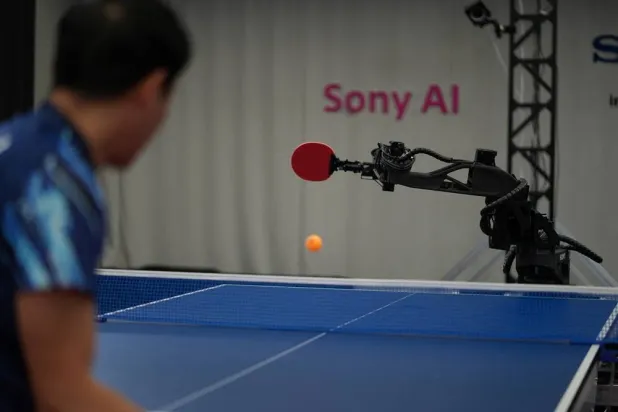
AI Robot 'Ace' Makes History by Defeating Top Human Table Tennis Players
Translated from English, summarized and contextualized by DistantNews.
TLDR
- Sony's AI robot, 'Ace,' has achieved a historic milestone by competing against and sometimes defeating top-level human table tennis players.
- Ace utilizes high-speed perception, AI-based control, and a state-of-the-art robotic system to achieve expert-level performance.
- This achievement in a physically demanding sport opens doors for advanced robotics in various real-world applications beyond gaming.
In a remarkable display of artificial intelligence and robotic prowess, Sony's AI robot, 'Ace,' has made history by demonstrating expert-level performance in table tennis, a sport demanding rapid decisions and precise execution. This achievement, realized in Tokyo, marks a significant leap forward in robotics, potentially heralding a new era for AI applications in complex physical domains.
Unlike computer games, where prior AI systems surpass human experts, physical and real-time sports such as table tennis remain a major open challenge due to their requirements for fast, precise and adversarial interactions near obstacles and at the edge of human reaction time.
Unlike previous table tennis robots, Ace is the first to rival highly skilled human competitors. Its success is attributed to a sophisticated system integrating high-speed perception, advanced AI control algorithms, and a cutting-edge robotic framework. The robot has competed against elite and professional human players, adhering to International Table Tennis Federation rules and officiated by licensed umpires, showcasing its capability in a real-world competitive setting.
The project's goal was not only to compete at table tennis but to develop insights into how robots can perceive, plan and act with human-like speed and precision in dynamic environments.
Peter Dürr, director of Sony AI Zurich and leader of the Ace project, highlighted that the goal extended beyond mastering table tennis. The project aimed to develop insights into how robots can perceive, plan, and act with human-like speed and precision in dynamic environments. The success of Ace, particularly its perception system and learning-based control, suggests that similar techniques could be applied to diverse fields such as manufacturing, service robotics, entertainment, and safety-critical applications, demonstrating the broad potential of this technological advancement.
The success of Ace, with its perception system and learning-based control algorithm, suggests that similar techniques could be applied to other areas requiring fast, real-time control and human interaction - such as manufacturing and service robotics, as well as applications across sports, entertainment and safety-critical physical domains.
DistantNews Editorial
Originally published by Asharq Al-Awsat in English. Translated, summarized, and contextualized by our editorial team with added local perspective. Read our editorial standards.
More Stories



From Our Blog

What Gets Lost (and Found) When News Is Translated

The Critical Role of Diaspora Media in Global News

What Travellers Should Know About Countries with Restricted Press

A Digital Nomad's Guide to Following Local News

How the Same Story Looks Different in Different Countries
