

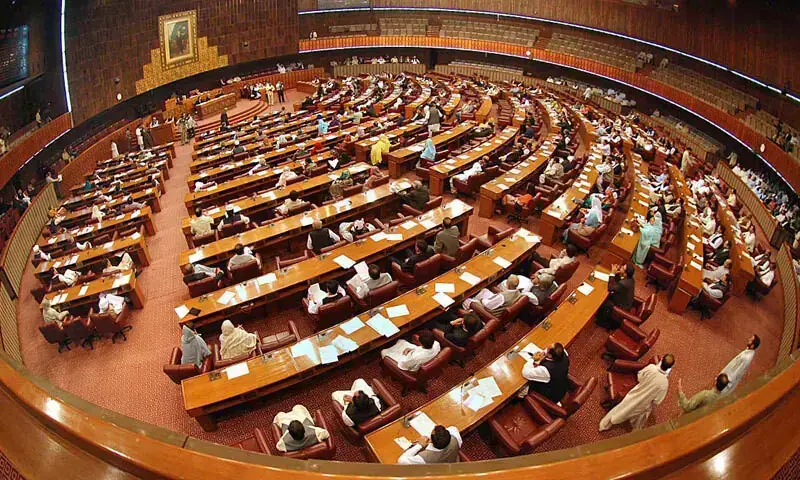
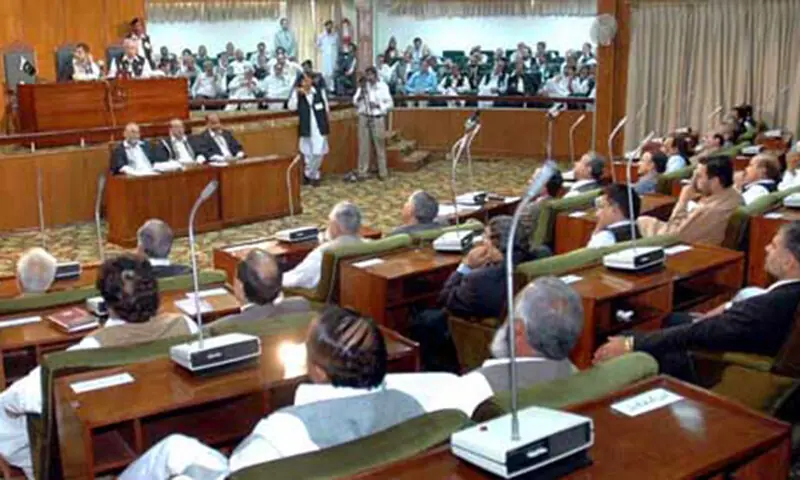
AJK Assembly passes Rs286 billion budget for FY27
Translated from English, summarized and contextualized by DistantNews.
At a glance
News
Named sources
New plan
- The Azad Jammu and Kashmir (AJK) Legislative Assembly passed a Rs286 billion budget for fiscal year 2026-27.
- The budget allocates Rs250 billion for recurring expenditure and Rs36 billion for development.
- Finance Minister Chaudhry Qasim Majeed presented the budget, highlighting efforts to boost revenue despite resource constraints.
The Azad Jammu and Kashmir (AJK) Legislative Assembly approved a Rs286 billion budget for the fiscal year 2026-27. The budget designates Rs250 billion for recurring expenditures and Rs36 billion for development projects, including Rs1 billion in foreign assistance.
Finance Minister Chaudhry Qasim Majeed presented the financial plan, emphasizing public welfare, transparency, and good governance as guiding principles amid severe resource constraints. He noted that the Inland Revenue Department had achieved a substantial portion of its collection targets, but the overall revenue target remained unmet due to factors like the State Bank of Pakistan’s reduced policy rate and lower electricity tariffs, which impacted receipts from education cess and property taxes.
The government had framed its financial plan despite severe resource constraints, with public welfare, transparency and good governance remaining its guiding principles.
Majeed reported that over 110 branches of more than 70 businesses are now integrated into the AJK Point-of-Sale invoicing system, a move expected to increase revenue from unregistered taxpayers significantly. Recurring expenditures will be funded by projected receipts of Rs250 billion, including AJK’s share in federal taxes, income tax, and internal receipts.
The entire Rs36 billion development budget will be financed through a federal development grant. The Communication and Works Department will receive the largest allocation of Rs14 billion, followed by significant funds for health, education, and energy and water resources. Other sectors receiving allocations include local government, physical planning, housing, agriculture, and information technology.
More than 110 branches of over 70 business entities had been integrated into the AJK Point-of-Sale (POS) invoicing system, which was expected to increase revenue from previously unregistered taxpayers by between 400 and 800pc.
DistantNews Editorial
Originally published by Dawn in English. Translated, summarized, and contextualized by our editorial team with added local perspective. Read our editorial standards.
More Stories

From Our Blog

What Gets Lost (and Found) When News Is Translated

The Critical Role of Diaspora Media in Global News

What Travellers Should Know About Countries with Restricted Press

A Digital Nomad's Guide to Following Local News

How the Same Story Looks Different in Different Countries
