


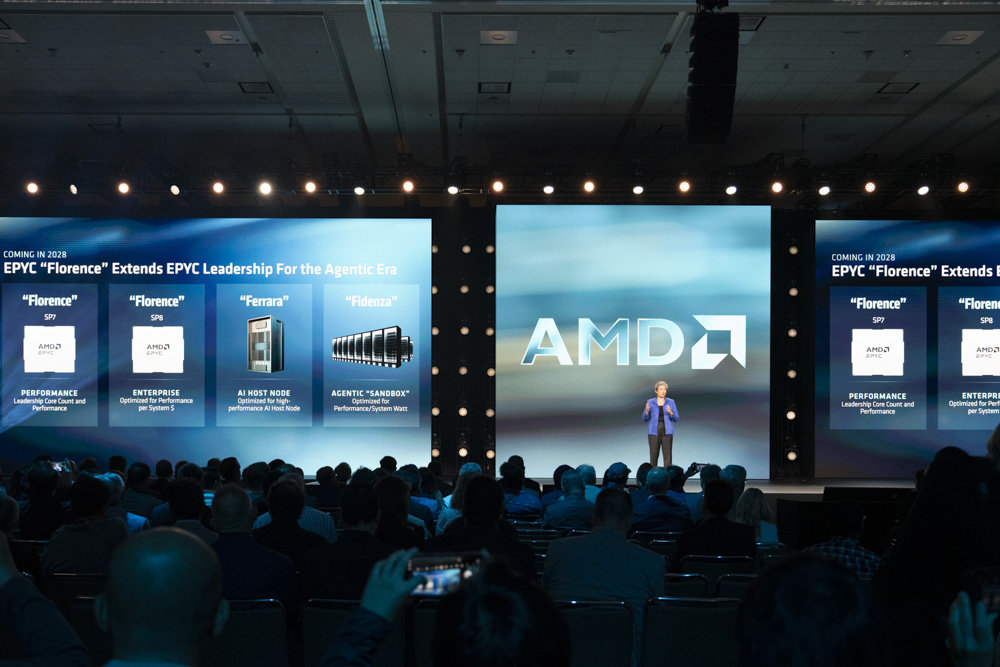
AMD outlines product roadmap through 2030, details new AI hardware
Translated from Korean, summarized and contextualized by DistantNews.
At a glance
News
Sources not specified
New plan
- AMD CEO Lisa Su unveiled the company's product roadmap through 2030 at the 'Advancing AI 2026' event in San Francisco.
- The roadmap includes the 6th generation EPYC server CPU codenamed 'Venice' with a 2nm process and PCIe 6.0 support, and the 7th generation EPYC CPU codenamed 'Florence' expected in 2028.
- New AI hardware, including the Instinct MI455X accelerator and a server rack named 'Helios,' were also showcased as part of AMD's AI strategy.
AMD CEO Lisa Su has laid out the company's ambitious product roadmap extending to 2030, signaling a strong focus on artificial intelligence hardware and next-generation server processors. Speaking at the 'Advancing AI 2026' event in San Francisco, Su revealed details about upcoming EPYC server CPUs and AI accelerators.
AMD's product roadmap and overview through 2030.
The centerpiece of the announcement was the upcoming 6th generation EPYC server CPU, codenamed 'Venice.' Built on the new Zen 6 architecture, this processor will utilize a 2nm process and introduce support for MRDIMM memory. Notably, it will be the first x86 processor to support the PCIe 6.0 standard, enhancing data transfer speeds.
The 6th generation EPYC server CPU is codenamed 'Venice' and is based on the Zen 6 architecture.
Looking further ahead, the 7th generation EPYC CPU, codenamed 'Florence,' is slated for release around 2028. This iteration will feature the Zen 7 architecture, designed with AI compute extensions and support for next-generation memory technologies like MRDIMM and LPDDR. AMD also teased future designs beyond Zen 7, indicating a sustained commitment to innovation in the server space.
The Zen 6 architecture applies a 2nm process and supports MRDIMM memory for the first time.
In addition to the CPUs, Su unveiled new AI hardware, including the Instinct MI455X AI accelerator and a server rack solution named 'Helios.' These products underscore AMD's strategy to provide comprehensive AI solutions, from individual components to integrated systems, aiming to capture a significant share of the rapidly growing AI market.
The 7th generation EPYC CPU is codenamed 'Florence' and is expected to be released around 2028.
DistantNews Editorial
Originally published by Dong-A Ilbo in Korean. Translated, summarized, and contextualized by our editorial team with added local perspective. Read our editorial standards.
More Stories


From Our Blog

What Gets Lost (and Found) When News Is Translated

The Critical Role of Diaspora Media in Global News

What Travellers Should Know About Countries with Restricted Press

A Digital Nomad's Guide to Following Local News

How the Same Story Looks Different in Different Countries
