

Anahuacalli, the museum built on petrified lava
Translated from Spanish, summarized and contextualized by DistantNews.
At a glance
In-depth
Sources not specified
Context piece
- The Anahuacalli Museum in Mexico City was conceived by Diego Rivera as a City of Arts on petrified lava.
- Designed with architectural input from Ruth Rivera and Juan O'Gorman, it was inaugurated in 1964.
- The museum houses Rivera's vast collection of over 60,000 pre-Hispanic artifacts, inspired by Mesoamerican temples.
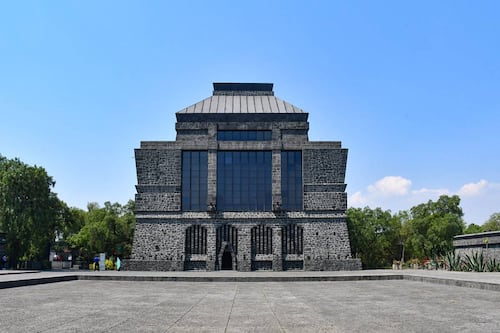
The Anahuacalli Museum, located in the Pedregal area of southern Mexico City, stands as a monumental testament to artist Diego Rivera's vision of a City of Arts. Conceived on a landscape of petrified lava, the museum integrates art, architecture, and nature, creating a unique environment inhabited by local wildlife like cacomixtles and bats.
Rivera, along with his daughter, architect Ruth Rivera, and architect Juan O'Gorman, developed the concept for this extraordinary space. O'Gorman, renowned for his work on the murals of the UNAM Central Library, continued the project with Ruth Rivera after Diego Rivera's death. The initial sketches for Anahuacalli date back to the early 1940s, and the museum was finally inaugurated in 1964, remaining under constant renovation since.
The name 'Anahuacalli' itself derives from Nahuatl, meaning 'house' (calli) of 'Anáhuac,' the ancient name for the territory of the Mexica civilizations. The structure is built from volcanic stone sourced from the Pedregal, a result of the Xitle volcano's eruption. Rivera envisioned it as a 'temple of art,' drawing inspiration from Mesoamerican architectural styles, including those of the Mexica, Teotihuacana, and Maya cultures.
Architecturally, the museum features a facade with taludes and tableros, characteristic of ancient Mesoamerican buildings. Its labyrinthine interior is designed to represent the three levels of the cosmos: the dark underworld on the ground floor, the world of the living on the first level, and the celestial plane on the top floor. This uppermost level is illuminated by a large window and offers an open-air viewpoint.
Beyond its architecture, Anahuacalli serves as a sanctuary for Rivera's extensive collection of over 60,000 pre-Hispanic artifacts. These pieces, many rescued from looting, include Teotihuacan masks, Olmec, Toltec, and Zapotec figurines, ceramics from western Mexico, and Mixtec incensarios. The museum also showcases Rivera's sketches, including those for 'The Man at the Crossroads,' the controversial mural commissioned for Rockefeller Center and later destroyed. This year, the museum also received the collection of art historian and writer Juan Rafael Coronel Rivera, Rivera's grandson.
DistantNews Editorial
Originally published by El Universal in Spanish. Translated, summarized, and contextualized by our editorial team with added local perspective. Read our editorial standards.
More Stories


From Our Blog

What Press Freedom Means for the News You Read

What Gets Lost (and Found) When News Is Translated

The Critical Role of Diaspora Media in Global News

What Travellers Should Know About Countries with Restricted Press

A Digital Nomad's Guide to Following Local News
