


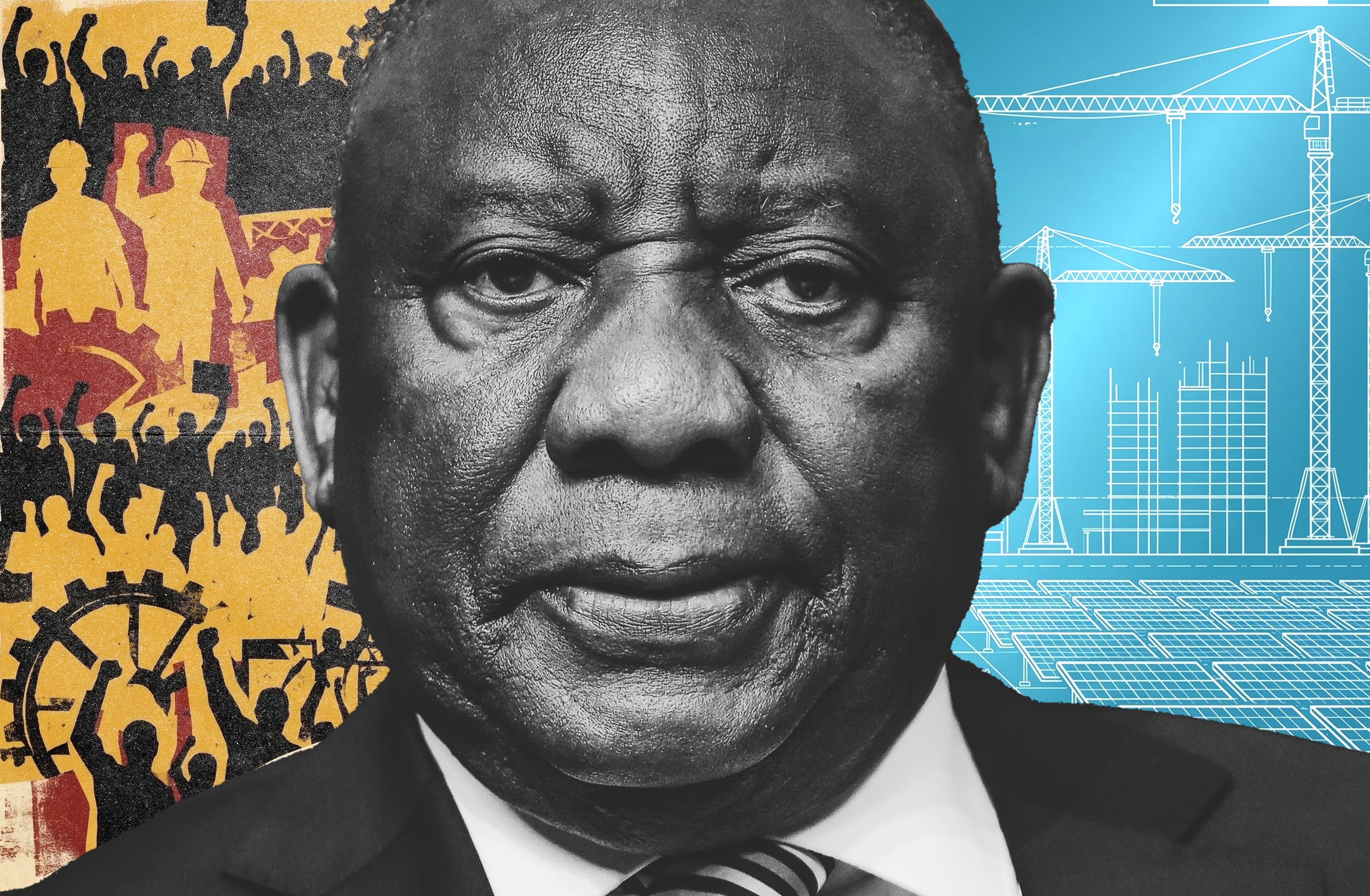
ANALYSIS: SA turns right as Ramaphosa hands economic levers to the private sector
Summarized by DistantNews. Read the original for the full story.
At a glance
Analysis
Named sources
Context piece
- President Cyril Ramaphosa used his weekly newsletter to argue that breaking up Eskom’s monopoly would increase competition and reduce electricity costs.
- The article argues that South Africa has steadily shifted economic control from the state toward private companies, especially in electricity, ports and railways.
- It says organised political opposition to the shift has been limited, while the ANC and its alliance partners have not mounted a substantive policy challenge.
President Cyril Ramaphosa’s strongest endorsement yet of free-market economics came as Eskom reported its annual results and reached agreement with Business Leadership South Africa over the utility’s unbundling process.
In his weekly newsletter, Ramaphosa argued that dividing Eskom into separate entities would increase competition and make electricity cheaper for consumers. He compared the proposal with the end of Telkom’s fixed-line monopoly, when telephone connections were expensive, access was limited and poorer and rural South Africans were largely excluded.
“The opening of the telecommunications sector to new operators fundamentally changed this picture. Competition brought massive new investment …the cost of communicating fell dramatically,” Ramaphosa wrote. His message, according to the analysis, was straightforward: state monopolies hold back progress, while private-sector competition drives investment and improves services.
was expensive, access was limited and millions of South Africans, particularly in poorer and rural communities, were effectively excluded
The shift extends beyond Eskom. Since at least 2019, the government has opened areas once controlled by the state to private companies. The article points to Eskom and Transnet as the clearest examples, arguing that private involvement has improved services. It describes this as the real reform of Ramaphosa’s government, bringing in business at the expense of the state.
Critics may point to Operation Vulindlela and say the purpose is to strengthen the private sector while weakening government. Whatever the intention, the article says the result is unmistakable: private companies now exert more influence over electricity, ports and railways than at any time since the colonial era. Parliamentary opposition has mainly come from the EFF and MK, while the ANC is consumed by internal disputes over municipal candidate lists. The traditional resistance that once might have come from within the ANC, the SACP or Cosatu has not stopped the shift. The article’s conclusion is blunt: the left has lost, and the right has won.
The opening of the telecommunications sector to new operators fundamentally changed this picture. Competition brought massive new investment …the cost of communicating fell dramatically.
About this summary
Originally published by Daily Maverick. Summarized and contextualized automatically by DistantNews, with a note on how the source frames the story. Not individually reviewed before publishing. How this works.
More Stories


From Our Blog

What Gets Lost (and Found) When News Is Translated

The Critical Role of Diaspora Media in Global News

What Travellers Should Know About Countries with Restricted Press

A Digital Nomad's Guide to Following Local News

How the Same Story Looks Different in Different Countries
