


Ancient quasars add to a 'major unsolved problem' in astrophysics
Summarized and contextualized by DistantNews.
At a glance
News
Sources not specified
Context piece
- Scientists discovered 31 ancient quasars, including the two earliest known, dating to 670 million years after the Big Bang.
- These findings add to a mystery about how supermassive black holes and advanced galaxies existed so early in the universe's history.
- The discovery, made using the European Space Agency's Euclid telescope, challenges current models of early cosmic evolution.
Scientists are baffled by the discovery of 31 ancient quasars, some dating to just 670 million years after the Big Bang, a period when the universe was only 5% of its current age. Observations from the European Space Agency's Euclid space telescope have identified these incredibly luminous objects, adding to a growing mystery about the early universe's advanced state.
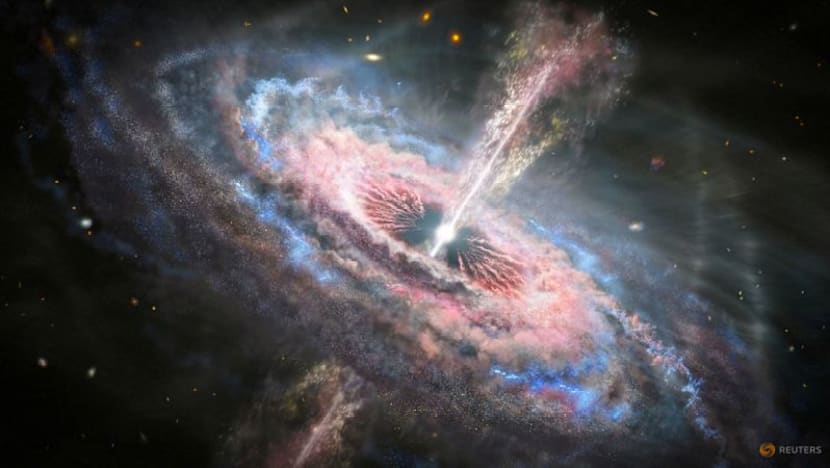
A quasar is the blazing core of a galaxy. At the center sits a giant black hole. Black holes themselves are dark, but the black hole's gravity pulls in gas and dust, which spiral toward it like water going down a drain. As this happens, the gas gets incredibly hot and shines brighter than the entire galaxy around it.
Among the findings are the two earliest quasars ever recorded, each shining with a brightness a trillion times greater than the sun. These quasars are powered by supermassive black holes, hundreds of millions to billions of times the mass of our sun. "A quasar is the blazing core of a galaxy," explained Daming Yang, lead author of the study from Leiden University. "At the center sits a giant black hole. Black holes themselves are dark, but the black hole's gravity pulls in gas and dust, which spiral toward it like water going down a drain. As this happens, the gas gets incredibly hot and shines brighter than the entire galaxy around it."
The discovery occurred during what scientists call the "epoch of reionization," or cosmic dawn. This era saw the first stars, galaxies, and black holes emerge, transforming the universe from a dense, foggy state into the transparent one observed today. "The universe back then was much smaller and denser, and filled with a fog of neutral hydrogen," Yang noted. "It was also a time of rapid change: the first stars, galaxies and black holes were lighting up and burning away that fog, transforming the universe into the transparent one we see today."
The universe back then was much smaller and denser, and filled with a fog of neutral hydrogen. It was also a time of rapid change: the first stars, galaxies and black holes were lighting up and burning away that fog, transforming the universe into the transparent one we see today.
Astrophysicist Joseph Hennawi of the University of California, Santa Barbara, and Leiden University highlighted the implications: "Everything was packed into a much smaller volume since the universe has expanded roughly eightfold in linear scale since then." He added, "The most important thing these distant quasars tell us is that these supermassive black holes were already present in the extremely early cosmic times. This does not provide very much time to grow these objects, because the universe is simply too young. This is a major unsolved problem."
Everything was packed into a much smaller volume since the universe has expanded roughly eightfold in linear scale since then. The most important thing these distant quasars tell us is that these supermassive black holes were already present in the extremely early cosmic times. This does not provide very much time to grow these objects, because the universe is simply too young. This is a major unsolved problem.
DistantNews Editorial
Originally published by CNA. Summarized and contextualized by our editorial team with added local perspective. Read our editorial standards.
More Stories



From Our Blog

What Gets Lost (and Found) When News Is Translated

The Critical Role of Diaspora Media in Global News

What Travellers Should Know About Countries with Restricted Press

A Digital Nomad's Guide to Following Local News

How the Same Story Looks Different in Different Countries
