


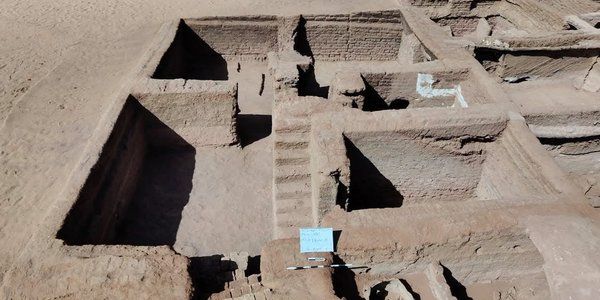
Ancient settlement with basilica and hundreds of inscribed shards discovered in Egypt's Dakhla Oasis
Translated from Polish, summarized and contextualized by DistantNews.
At a glance
News
Official statement
Outcome reported
- Archaeologists in Egypt's New Valley province discovered a well-preserved ancient settlement in the Dakhla Oasis.
- The mud-brick settlement features a planned urban layout, residential homes, and a 4th-century basilica, offering insights into late antiquity life.
- Excavations also yielded around 200 pottery shards inscribed in Coptic and Greek, providing details on daily life, trade, and language use.
Archaeologists have unearthed a remarkably preserved ancient settlement in Egypt's Dakhla Oasis, shedding new light on life during late antiquity. The discovery, made by an Egyptian archaeological mission, is located in the New Valley province on the Western Desert's edge.
The settlement was planned according to an orderly urban layout. The main streets ran from north to south, and cross streets from east to west, creating squares and open spaces.
The settlement, constructed from mud bricks, showcases an organized urban plan with streets running north-south and east-west, creating squares and open spaces. At its heart, facing a main street, stands a basilica dating to the mid-4th century CE. The site appears to have combined residential, religious, and defensive functions.
Mahmoud Masoud, director of Dakhla Oasis antiquities and head of the mission, detailed the findings: houses with large halls and vaulted ceilings, bread ovens, kitchens, millstones, two watchtowers, and a fortress with thick walls. Of particular interest are two houses identified as belonging to church deacon Tisus and Tabipus. The Tabipus house, from the early 4th century, is believed to have served as a house church before the basilica's construction. Confirming this could illuminate the evolution of local Christian worship from private gatherings to a dedicated temple.
If this hypothesis is confirmed, it will allow us to reconstruct the development of local Christian worship – from a private place of assembly to a temple built specifically for the community.
This interpretation aligns with previous research in nearby Kellis, where papyri and ostraca documented religious shifts between the 3rd and 4th centuries. The most valuable finds include approximately 200 inscribed pottery shards, known as ostraca, in Coptic and Greek. These everyday notes offer invaluable insights into how residents conducted trade, communicated, managed property, and used language. The presence of both Greek and Coptic reflects the ongoing importance of Greek in administration and written culture in late antique Egypt.
For archaeologists, such documents often have greater cognitive value than monumental buildings, as they show how residents traded, communicated, managed property, and used language on a daily basis.
DistantNews Editorial
Originally published by Rzeczpospolita in Polish. Translated, summarized, and contextualized by our editorial team with added local perspective. Read our editorial standards.
More Stories


From Our Blog

What Gets Lost (and Found) When News Is Translated

The Critical Role of Diaspora Media in Global News

What Travellers Should Know About Countries with Restricted Press

A Digital Nomad's Guide to Following Local News

How the Same Story Looks Different in Different Countries
