


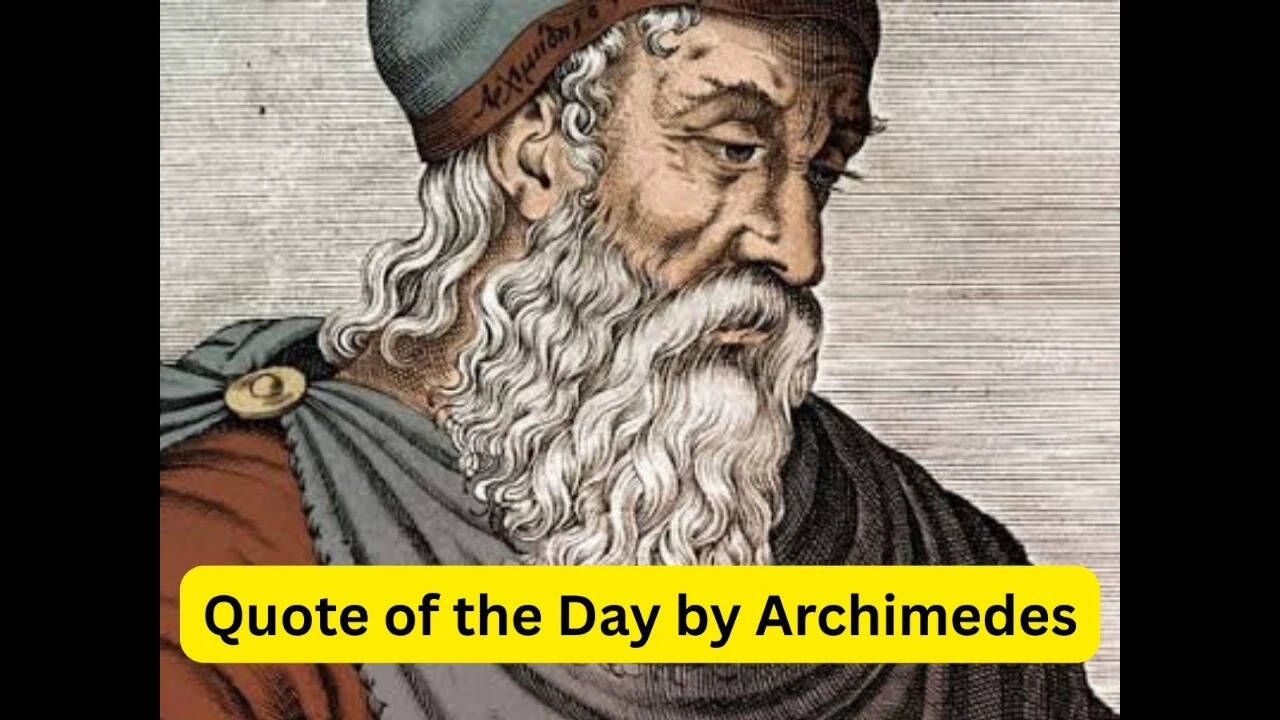
Archimedes' 'lever' quote: A lesson in physics and life
Translated from English, summarized and contextualized by DistantNews.
At a glance
In-depth
Named sources
Context piece
- The article presents a quote from the ancient Greek mathematician Archimedes: 'Give me a place to stand, a lever long enough and a fulcrum on which to place it, and I shall move the World.'
- It explores Archimedes' life, contributions to mathematics and physics, and his inventions, including the Archimedes screw and buoyancy principle.
- The piece also touches on his defensive war machines and his death during the Roman siege of Syracuse.
Archimedes, an ancient Greek mathematician, physicist, engineer, astronomer, and inventor, born around 287 BC in Syracuse, is regarded as one of history's greatest minds. His famous quote, 'Give me a place to stand, a lever long enough and a fulcrum on which to place it, and I shall move the world,' originally rooted in physics, has evolved into a widely interpreted life lesson.
Archimedes' father, an astronomer, likely introduced him to mathematics and the stars early on. He studied in Alexandria, Egypt, then the world's intellectual hub, before returning to Syracuse. His work laid the groundwork for modern calculus and established the field of statics. He developed methods for calculating areas and volumes of complex geometric shapes.
Give me a place to stand, a lever long enough and a fulcrum on which to place it, and I shall move the World.
As a practical inventor, Archimedes addressed King Hiero II of Syracuse's engineering challenges. He designed the Archimedes screw, a device for lifting water, and famously discovered the principle of buoyancy. Legend has it that upon realizing that the volume of displaced water equaled the volume of a submerged object, he leaped from his bath and ran through the streets shouting "Eureka!" ("I have found it!") after solving the king's problem about a gold crown's purity.
Eureka!
During the Roman siege of Syracuse, Archimedes designed formidable defense machines. These included powerful catapults, the Claw of Archimedes to lift enemy ships, and giant mirrors to set ships ablaze using sunlight. Despite his efforts, Syracuse fell to the Romans in 212 BC. Archimedes was killed by a Roman soldier while engrossed in drawing geometric diagrams, reportedly uttering his last words, "Do not disturb my circles."
The quote itself stems from Archimedes' formalization of the mathematical principles behind levers, a fundamental concept in simple machines. It speaks to the power of leverage and finding the right point of application to achieve significant results, whether in physics or in life.
Do not disturb my circles.
DistantNews Editorial
Originally published by Times of India in English. Translated, summarized, and contextualized by our editorial team with added local perspective. Read our editorial standards.
More Stories


From Our Blog

What Press Freedom Means for the News You Read

What Gets Lost (and Found) When News Is Translated

The Critical Role of Diaspora Media in Global News

What Travellers Should Know About Countries with Restricted Press

A Digital Nomad's Guide to Following Local News
