


Artifact from King Muryeong's Tomb Identified as Royal Coffin Trim
Translated from Korean, summarized and contextualized by DistantNews.
At a glance
News
Sources not specified
Context piece
- A presumed decorative artifact from the Tomb of King Muryeong, identified as 'Heukchil-eun-geumgu' (black lacquered silver fittings), has been confirmed as a silver decorative trim for the king's coffin.
- Scientific analysis revealed the artifact's placement on the coffin's edges and its composition, clarifying its function after previous speculation it was a 'geomungo' (zither) decoration.
- The study, published in 'Museum Conservation Science,' also details the restoration of other coffin fittings and analyzes the materials used, offering insights into Baekje royal metal craftsmanship.
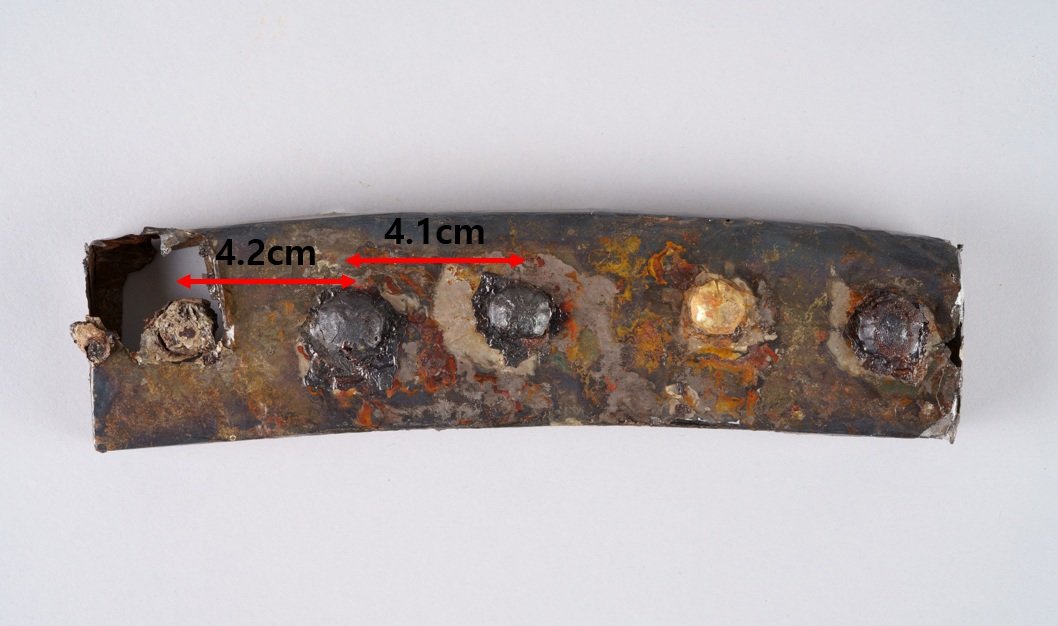
An artifact previously thought to be a decorative element for a 'geomungo' zither has been definitively identified as a silver trim adorning the wooden coffin of a Baekje king. The object, known as 'Heukchil-eun-geumgu' (black lacquered silver fittings), was unearthed from the Tomb of King Muryeong.
Research published in the 35th issue of 'Museum Conservation Science,' a journal by the National Museum of Korea, confirmed the artifact's purpose. Through comprehensive analysis of its placement with coffin nails, its hexagonal shape, and its curvature against the coffin's side, researchers determined it served as a decorative finish for the front, back, and edges of the royal coffin.
During the conservation process, researchers successfully restored five additional fittings previously classified as miscellaneous fragments. This brings the total confirmed number of decorative fittings for King Muryeong's coffin to 14, including hexagonal, rectangular, and side pieces. Scientific analysis revealed the silver plates used were of high purity (98-99% silver). The black surface, contrary to earlier assumptions, was not black lacquer but a result of silver corrosion.
This is an important basis showing that a dedicated accessory frame was created separately from the main coffin body to reinforce the shape and combine the fittings during production.
Further examination of the wooden frame within the fittings indicated it was made of cypress, distinct from the Korean golden cypress used for the coffin itself. This suggests the fittings were assembled with a dedicated supporting frame. The study also highlights the evolution of Baekje royal metal craftsmanship, noting a transition from the elaborate silver decorations of the Ungjin period (King Muryeong's reign) to simpler designs in later periods.
The 'Museum Conservation Science' journal also features other research, including the restoration of a ceremonial badge belonging to Heungseon Daewongun and an analysis of a wooden statue of Guanyin Bodhisattva from the National Gyeongju Museum. These studies utilize scientific methods to uncover historical details and conservation techniques for cultural heritage.
This shows the technical evolution of Baekje royal metal craftsmanship, which gradually simplified from the splendid silver decorations of the Ungjin period Muryeong Royal Tomb to the Buyeo Neungsan-ri Dongha-chong and Iksan Ssangeung Daewangmyo of the Sabbi period.
DistantNews Editorial
Originally published by Dong-A Ilbo in Korean. Translated, summarized, and contextualized by our editorial team with added local perspective. Read our editorial standards.
More Stories


From Our Blog

What Gets Lost (and Found) When News Is Translated

The Critical Role of Diaspora Media in Global News

What Travellers Should Know About Countries with Restricted Press

A Digital Nomad's Guide to Following Local News

How the Same Story Looks Different in Different Countries
