


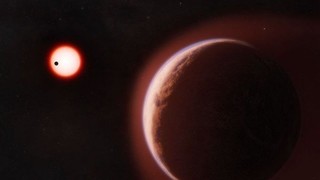
Atmosphere Detected on Earth-Like Exoplanet LHS 1140 b, Boosting Search for Life
Translated from Spanish, summarized and contextualized by DistantNews.
At a glance
News
Named sources
Context piece
- Scientists have detected an atmosphere on the exoplanet LHS 1140 b, located 40 light-years away, marking a significant step in the search for Earth-like life beyond our solar system.
- This discovery is the most robust evidence to date of a world with conditions similar to Earth's in terms of composition and temperature, capable of supporting life.
- LHS 1140 b is about 5.6 times Earth's mass and orbits a red dwarf star, with its temperature suitable for liquid water, though its surface composition remains unknown.
In a landmark discovery, scientists have detected an atmosphere on the exoplanet LHS 1140 b, a finding that represents a crucial milestone in the ongoing quest for potentially habitable worlds beyond our solar system. Located approximately 40 light-years from Earth, this exoplanet, first identified in 2017, now offers the most compelling evidence to date of a planet possessing conditions conducive to life, similar to those found on Earth.
The research, published in the journal Science and involving a consortium of prestigious U.S. universities, confirms the existence of worlds with comparable atmospheric composition and temperature ranges to Earth. While atmospheres have previously been identified on gas giants like Uranus and Neptune, this is the first time such a detection has been made on an exoplanet considered Earth-like.
LHS 1140 b is a substantial planet, boasting roughly 5.6 times the mass of Earth and about 1.7 times its radius. It orbits an older red dwarf star in a rapid 24.7-day cycle. Its characteristics align with those of a rocky world, receiving 42% of its host star's radiation. This positioning within the habitable zone suggests temperatures suitable for liquid water, a key ingredient for life as we know it.
Helium was a clear proof of the existence of an atmosphere on an exoplanet located in the habitable zone. It was absolutely exciting to see the transit spectra and to realize little by little the implications of what we were observing.
Scientists detected evidence of helium escaping from LHS 1140 b's atmosphere in 2024 using the powerful spectrograph on the Magellan Clay telescope in Chile. Spectrographs analyze the light from celestial objects, breaking it down to reveal their composition. When starlight passes through an exoplanet's atmosphere, astronomers can identify the elements present.
"Helium was a clear proof of the existence of an atmosphere on an exoplanet located in the habitable zone. It was absolutely exciting to see the transit spectra and to realize little by little the implications of what we were observing," said Shreyas Vissapragada of the Carnegie Observatory in California. While the planet's exact surface conditions are still unknown, researchers believe it may be a hybrid world, potentially featuring vast oceans or a composition akin to ice giants like Uranus and Neptune.
What we believe, and what the new data seem to confirm, is that LHS 1140 b is a world halfway between an ocean world (completely covered in water, with oceans hundreds of kilometers deep) and an ice giant similar to Uranus and Neptune, whose basic composition is hydrogen.
DistantNews Editorial
Originally published by El Deber in Spanish. Translated, summarized, and contextualized by our editorial team with added local perspective. Read our editorial standards.
More Stories



From Our Blog

What Gets Lost (and Found) When News Is Translated

The Critical Role of Diaspora Media in Global News

What Travellers Should Know About Countries with Restricted Press

A Digital Nomad's Guide to Following Local News

How the Same Story Looks Different in Different Countries
