


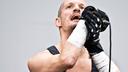
Austrian artist Michael Turinsky turns disability into political power
Translated from Croatian, summarized and contextualized by DistantNews.
At a glance
In-depth
Sources not specified
Context piece
- Vienna-based choreographer, performer, and philosopher Michael Turinsky is presenting his award-winning solo performance "Precarious Moves" at the Zagreb Youth Theatre.
- Turinsky, an artist with a disability, uses his physical specificity to radically question dominant norms of movement, dance, and physicality, coining the term "crip choreography."
- His work challenges the societal obsession with speed and productivity by celebrating vulnerability, slowness, and precariousness as spaces of freedom and critical thought.
Vienna-based choreographer, performer, and philosopher Michael Turinsky is bringing his acclaimed solo performance "Precarious Moves" to the Zagreb Youth Theatre on June 30. Turinsky is not just another name on the European dance scene; he is an artist with a disability who uses his unique physical characteristics as a fundamental tool to subversively reorganize our understanding of movement, dance, and physicality.
His work, situated at the intersection of contemporary dance, theory, and politics, does not seek pity or mere inclusion. Instead, it constructs a completely new body language that celebrates resistance, slowness, and precariousness as pathways to genuine freedom and critical reflection on a society obsessed with speed and productivity. Academically trained as a philosopher at the University of Vienna, Turinsky entered the world of inclusive dance in 2006. However, he soon began to question the very concept of "inclusion," finding it insufficient and often patronizing.
Seeking a more precise description for his practice, he coined his own term: "crip choreography." This term does not merely describe dance by people with disabilities but signifies a radical artistic practice that engages with the specific, resistant materiality of the body to undermine and reorganize dominant forms and qualities of movement. His choreography is not an attempt to imitate the movements of "able" bodies but an exploration of the unique possibilities arising from a body that resists normative demands. Turinsky adopts the term "crip" from the theoretical works of Robert McRuer, linking it to "queer" theory. Just as "queer" signifies resistance to heteronormativity, "crip" signifies an inherent resistance to what McRuer calls "compulsory ableism", the societal pressure for bodies to move and function in precisely defined, normalized ways.
For Turinsky, this is not just an abstract idea but a lived reality. His work does not speak of the general vulnerability of the human body, which we have all experienced during the pandemic, but of the specific resistance his body offers to imposed forms of mobilization. Through his art, he poses crucial questions: What if our fetishization of speed stems from a sense of societal stagnation? What if the resistant slowness of his movements could be read as social progress? At the core of his poetics lies a multi-layered concept of resistance. On one hand, it is the resistance his body offers to external demands and societal impositions of mobilization. On the other hand, it is also the body's resistance to its own subjective intentions for movement. Turinsky views this dual resistance not as an obstacle but as a productive force.
What if our fetishization of speed stems from a sense of societal stagnation? What if the resistant slowness of his movements could be read as social progress?
DistantNews Editorial
Originally published by Večernji List in Croatian. Translated, summarized, and contextualized by our editorial team with added local perspective. Read our editorial standards.
More Stories
From Our Blog

What Gets Lost (and Found) When News Is Translated

The Critical Role of Diaspora Media in Global News

What Travellers Should Know About Countries with Restricted Press

A Digital Nomad's Guide to Following Local News

How the Same Story Looks Different in Different Countries
