

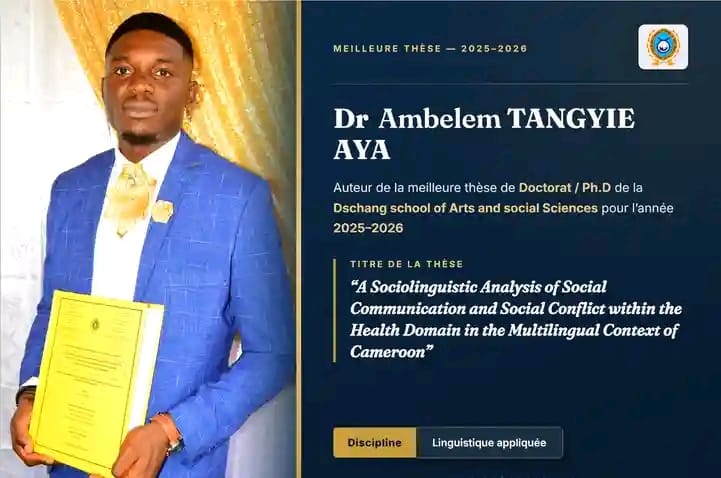
Award-winning Dschang thesis finds 60% of Cameroonians excluded from health messages
Translated from French and summarized by DistantNews. Read the original for the full story.
At a glance
In-depth
Documents & data
Outcome reported
- Dr Ambelem Tangyie Aya-Nwi received the Dschang School of Arts and Social Sciences award for the best doctoral thesis of 2025-2026.
- The study says linguistic exclusion leaves 60% of Cameroonians outside public health messaging and calls for changes to government communication.
- The research drew on four years of fieldwork, 500 questionnaires and 100 interviews in Dschang, Bamenda and Douala, including work during the anglophone crisis and the COVID-19 pandemic.
A doctoral thesis in Cameroon argues that language, rather than medicine, can become the biggest barrier to receiving health information. Its author, Dr Ambelem Tangyie Aya-Nwi, has won the award for the best thesis of the 2025-2026 academic year at the Dschang School of Arts and Social Sciences.
The research says linguistic exclusion prevents 60% of Cameroonians from accessing health messages. It calls for a redesign of public communication so that health information can reach people in the country’s multilingual setting.
Titled "A Sociolinguistic Analysis of Social Communication and Social Conflict within the Health Domain in the Multilingual Context of Cameroon," the thesis was supervised by Professor Emmanuel Nforbi. Aya-Nwi conducted four years of research in Dschang, Bamenda and Douala.
The study used 500 questionnaires and 100 interviews. The fieldwork included the period of Cameroon’s anglophone crisis and the COVID-19 pandemic, placing communication problems within two periods when access to clear health information carried particular weight.
The findings present the issue as a political challenge for Cameroon’s health system, which the research says does not sufficiently account for the country’s linguistic diversity.
About this summary
Originally published by Journal du Cameroun in French. Translated, summarized, and contextualized automatically by DistantNews, with a note on how the source frames the story. Not individually reviewed before publishing. How this works.
More Stories


From Our Blog

What Gets Lost (and Found) When News Is Translated

The Critical Role of Diaspora Media in Global News

What Travellers Should Know About Countries with Restricted Press

A Digital Nomad's Guide to Following Local News

How the Same Story Looks Different in Different Countries
