

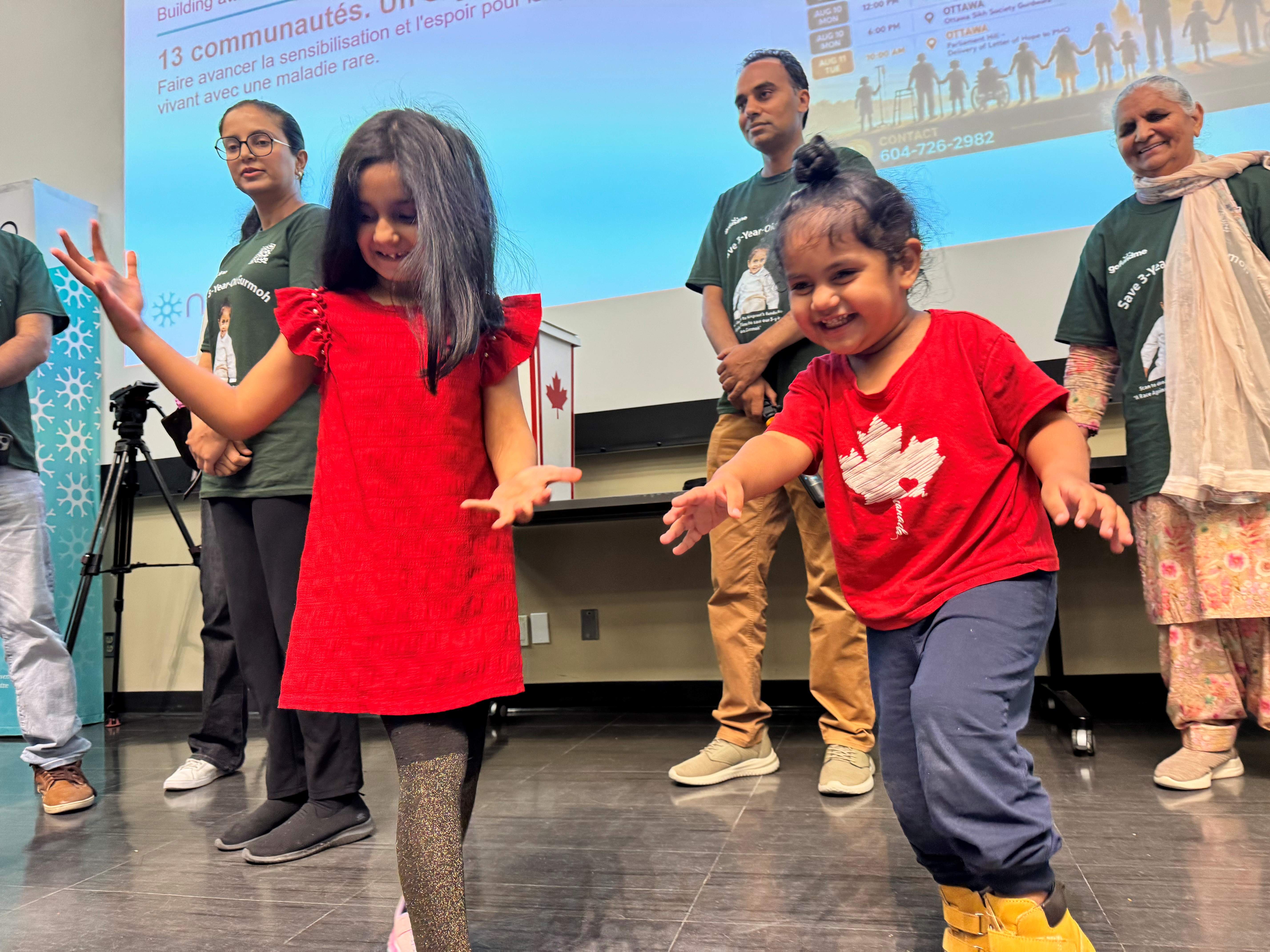
B.C. family finds hope in Montreal researchers to fight son’s rare disease
Summarized and contextualized by DistantNews.
At a glance
In-depth
Sources not specified
Context piece
- A three-year-old boy, Gurmoh Gill, is battling a rare, incurable genetic disease called hereditary spastic paraplegia (HSP).
- Researchers at Montreal's Neuro are investigating Gurmoh's genetic information to find a treatment that could slow the disease's progression.
- Gurmoh's parents are raising awareness and funds for rare diseases through a "Journey of Hope" across Canada, advocating for equal access to medicine.
For the Gill family, the diagnosis of hereditary spastic paraplegia (HSP) for their three-year-old son, Gurmoh, presented a bleak outlook. HSP is a rare genetic condition causing progressive stiffness and weakness, primarily in the legs, with the potential to affect speech, arm function, and cognitive abilities. Gurmoh's parents, Navpreet and Stalin Gill, described the initial diagnosis as overwhelming, with no available medicine and the prospect of their son losing developmental milestones.
From that moment when you are told that there is no hope, not a single medicine you can give to your child, and your child is going to go backwards, all those milestones that you once celebrated, the first walk, their speech, they’re going to lose everything.
After exhausting other avenues, the Gills reached out to Montreal's Neuro in January and found a glimmer of hope. Researchers there are now working with Gurmoh's genetic data, aiming to develop a treatment that targets the specific mutation responsible for HSP. The primary goal is not to reverse existing damage but to create a therapy that could potentially slow the disease's progression.
It was incredible; it’s hard to explain it in words. This hope is what gives you that power to go on, to look for the answers and to fight for your child.
"If we can fix the problem at the source, fix the DNA, fix the mutation that causes the disease, that’s the best-case scenario," said Ziv Gan-Or, director of clinical research at The Neuro. "That would be the biggest hope."
If we can fix the problem at the source, fix the DNA, fix the mutation that causes the disease, that’s the best-case scenario. That would be the biggest hope.
This research has galvanized the Gills, who have embarked on a "Journey of Hope" across Canada. Their mission is to raise funds, increase awareness about rare diseases, and collect letters from other affected individuals. They plan to deliver these letters to the prime minister's office, advocating for greater resources and equitable access to medicine for all Canadians, asserting that "Medicine should be the right of each and every Canadian."
You can’t have inequality in terms of who should get medicine and who shouldn’t. Medicine should be the right of each and every Canadian.
DistantNews Editorial
Originally published by Global News. Summarized and contextualized by our editorial team with added local perspective. Read our editorial standards.
More Stories

From Our Blog

What Gets Lost (and Found) When News Is Translated

The Critical Role of Diaspora Media in Global News

What Travellers Should Know About Countries with Restricted Press

A Digital Nomad's Guide to Following Local News

How the Same Story Looks Different in Different Countries
