


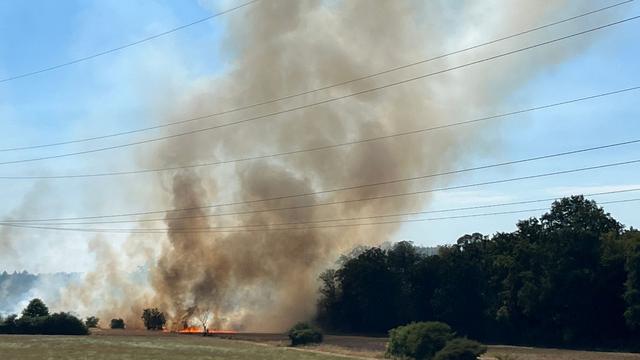
Baden-Württemberg Firefighters Prepare for Increased Wildfire Risk Amid Climate Change
Translated from German, summarized and contextualized by DistantNews.
At a glance
News
From a news agency
Context piece
- Wildfire risk is increasing in Baden-Württemberg due to climate change and prolonged dry periods.
- Fire departments are preparing for scenarios previously seen mainly in Southern Europe, seeking knowledge from countries with more experience.
- Strategies include enhanced collaboration between forestry services and fire departments, improved prevention, and utilizing the region's extensive forest road network for rapid response.
Baden-Württemberg's fire departments are proactively preparing for an increased risk of large wildfires, a scenario long associated with Southern Europe but now a growing concern in Germany due to climate change. Stefan Hermann, commander of the Reutlingen fire department and vice president of the state fire brigade association, stated, "We are aware of climate change and are preparing for it. The next major wildfire is only a matter of time." He noted that extended dry spells heighten the likelihood of small fires rapidly escalating.
To combat this, the fire service is adopting a strategy of "staying ahead of the situation," which involves closer cooperation with forestry services and authorities. A key initiative is the "Integrated Wildfire Management" platform, where various organizations develop recommendations and concrete strategies for wildfire protection. This includes a focus on prevention and establishing strong partnerships between forestry experts and firefighters for ground-level firefighting.
We are aware of climate change and are preparing for it. The next major wildfire is only a matter of time.
Hermann highlighted that Baden-Württemberg's advantage lies in its dense network of forest roads, typically no more than 300 to 500 meters apart. This accessibility means specialized vehicles are not always necessary, and initial response teams can reach fires quickly. "This means that as soon as smoke is seen from the forest and someone recognizes it, they call 112, and within 10 minutes, the first fire engine arrives," Hermann explained. He added that if a fire escalates, additional units and specialized equipment are deployed.
The fire service is also actively seeking expertise from abroad. Hermann is currently in Croatia for training, observing how their colleagues manage wildfires, acknowledging that the conditions there differ. This international knowledge exchange is crucial as the region adapts to changing environmental conditions and prepares for future challenges.
This means that as soon as smoke is seen from the forest and someone recognizes it, they call 112, and within 10 minutes, the first fire engine arrives.
DistantNews Editorial
Originally published by Die Zeit in German. Translated, summarized, and contextualized by our editorial team with added local perspective. Read our editorial standards.
More Stories


From Our Blog

What Gets Lost (and Found) When News Is Translated

How the Same Story Looks Different in Different Countries

The Critical Role of Diaspora Media in Global News

What Travellers Should Know About Countries with Restricted Press

A Digital Nomad's Guide to Following Local News
