


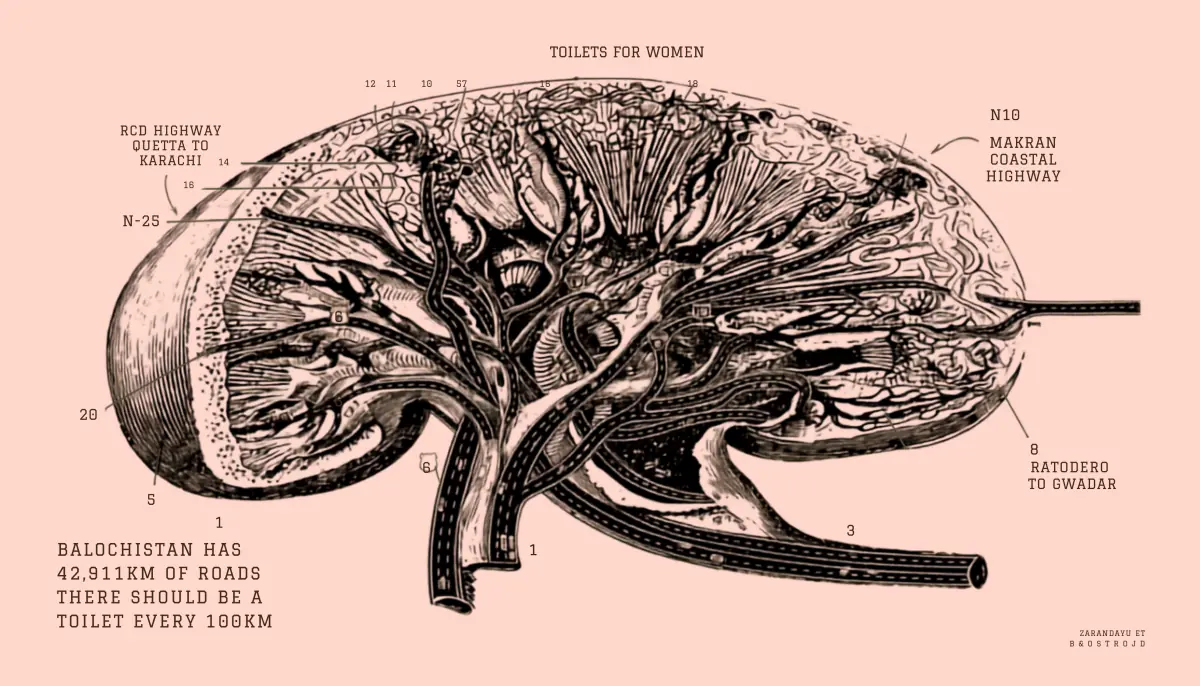
Balochistan highways lack restrooms, women take issue to court
Translated from English, summarized and contextualized by DistantNews.
At a glance
News
Named sources
Context piece
- Balochistan's new highways lack essential public restrooms, forcing women to endure long journeys without access to sanitation.
- Three women have filed a court petition arguing the highway design prioritizes commerce over human safety and equity, violating constitutional rights.
- The lawsuit highlights the disparity in access to basic facilities, particularly for women, along major routes in Pakistan's Balochistan province.
Balochistan's new highways, lauded as corridors of connectivity and trade, are failing to provide a basic necessity: public restrooms. This oversight disproportionately affects women, who face significant challenges due to social and cultural restrictions.
The lack of accessible and safe sanitation facilities along routes like the Makran Coastal Highway, stretching from Gwadar to Turbat and beyond, forces travelers, especially women, to endure long journeys with limited access to water and privacy. Makeshift bathrooms are often rudimentary, lacking proper locks or running water, and are frequently located in male-dominated spaces.
Three women, Kulsoom Baloch, Fauzia Shaheen, and Dr. Quratulain Bakhtiari, have taken the issue to the Balochistan High Court. They argue that the highway design deliberately prioritizes commercial interests over human safety, accessibility, and equity, violating constitutional rights to life, dignity, and movement.
Their petition points to specific stretches, like the one between Mastung and Kalat, where no women's restrooms exist. Even planned upgrades, such as the widening of the Karachi to Quetta-Chaman N-25 Highway, reportedly omit these crucial facilities. The legal challenge underscores a broader issue of neglecting basic human needs in favor of infrastructure development.
Men are socially free. They can go anywhere for nature’s call. Women are restricted socially and culturally, and their biological needs are different.
DistantNews Editorial
Originally published by Dawn in English. Translated, summarized, and contextualized by our editorial team with added local perspective. Read our editorial standards.
More Stories


From Our Blog

What Gets Lost (and Found) When News Is Translated

The Critical Role of Diaspora Media in Global News

What Travellers Should Know About Countries with Restricted Press

A Digital Nomad's Guide to Following Local News

How the Same Story Looks Different in Different Countries
